

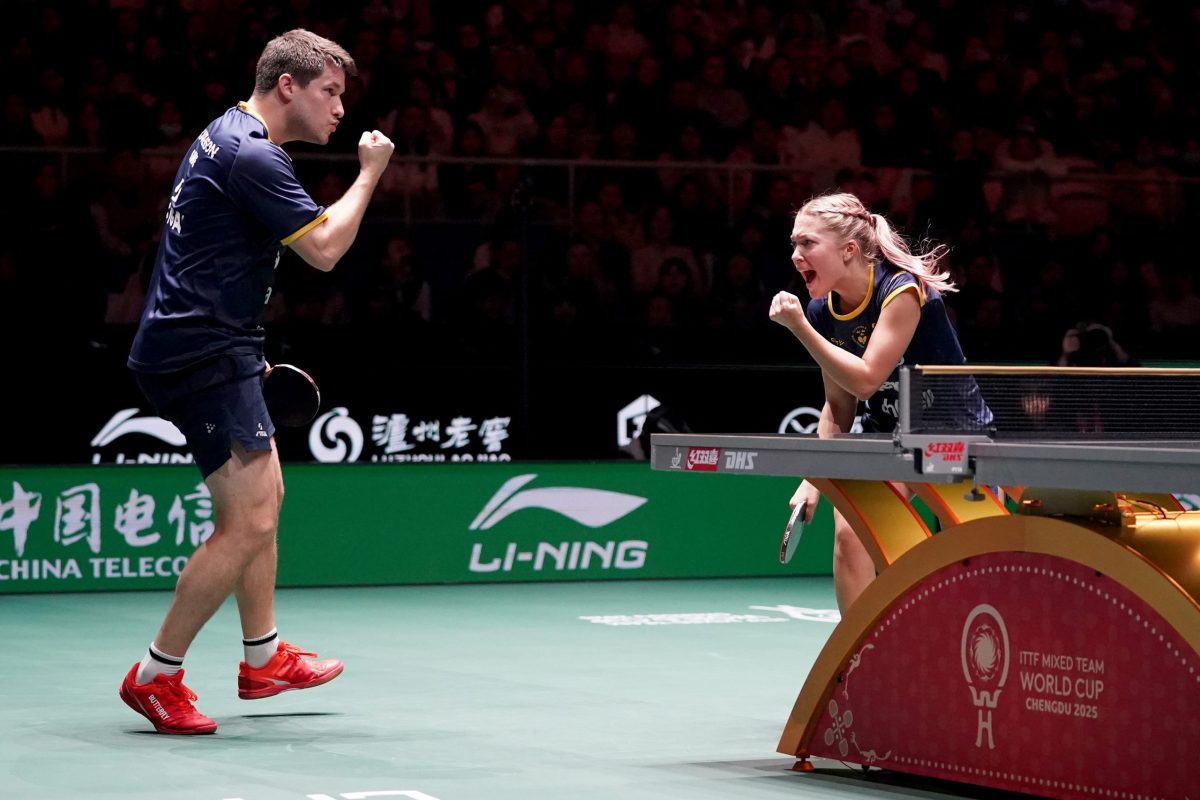
Kristian Karlsson and Christina Kallberg (Photo ITTF)
A rampant Sweden demolished Chinese Taipei 8-2, saving their best in their do-or-die clash at the ITTF Mixed Team World Cup in Chengdu.
Kristian Karlsson-Christina Kallberg stunned the World No. 8 Chinese Taipei pairing of Lin Yun-Ju-Cheng I-Ching, striking an early blow in the mixed doubles. The Swedish duo took the opener 11-7, then battled through a roller-coaster second game to edge it 18-16. Though they dropped the third, the damage was already done, as Sweden surged ahead with a 2-1 lead.
Linda Bergstrom performance outstandingly in the women’s singles for Sweden, securing a gritty 3-0 victory against Huang Yu-Chiao. She underlined why she is regarded as one of the most improved players in recent years. After grinding out a marathon 17-15 win in the opening game, she carried that momentum forward, dominating the second and third. From her backhand side, Bergstrom’s chopping style proving highly effective.
She cleverly mixed in sudden side-spin chops alongside her trademark backspin, saving that variation for crucial points and leaving Huang repeatedly unsettled. Bergstrom’s win extended Sweden’s lead to 5-1.
Anton Kallberg extended Sweden’s advantage to 7-2 with a commanding men’s singles performance against Lin Yen-Chun, who was once again preferred over Kao Cheng-Jui. Kallberg punished Lin relentlessly with his forehand and unveiled a newly developed topspin long serve to the backhand, racing through the first two games. Yen-Chun managed a consolatory third, but the damage was already done.
Kallberg then partnered Kristian Karlsson in the men’s doubles. Wasting no time, they took down Lin Yun-Ju-Kao Cheng-Jui in a single game. Their emphatic win over the World No. 5 pairing sealed the win for Sweden, and booked their spot in Stage 2 of the competition.
Hong Kong also produced the goods when it mattered, beating African giants Egypt 8-2 in a do-or-die clash. Egypt, boosted by the return of Hana Goda from the recently concluded World Youth Championships, created opportunities but failed to capitalize. As a result, their campaign came to an end.
Baldwin Chan-Zhu Chengzhu combined in the mixed doubles to overcome the solid Egyptian duo of Youssef Abdelaziz-Mariam Alhodaby. After a tense battle, Chan-Chengzhu closed it out 11-6 in the decider to secure a 2-1 lead.
The highlight of the tie was the women’s singles, as Doo Hoi Kem overcame Egypt’s Hana Goda 3-0. With both players evenly matched, they produced thrilling rallies that kept the crowd enthralled. The young and animated Goda added entertainment value with her strokeplay and lively antics, drawing plenty of attention.
She had her chances, narrowly losing 9-11 in the first and letting slip 10-8 lead in the third. Ultimately, the difference lay in Hoi Kem’s composure at the critical moments, which carried her to victory.
Wong Chun Ting then secured a crucial 2-1 win over Egyptian legend Omar Assar in the men’s singles, effectively neutralizing Egypt’s biggest threat. Chun Ting was at his attacking best, showing far greater consistency with his reverse pen-hold backhand and nullifying Assar’s attempts to exploit that wing. He also made full use of the wrist flexibility afforded by his pen-hold grip, varying his receive cleverly and denying Assar any clear attacking opportunities.
Leading 7-2, the stage was set for the World No. 1 men’s doubles pair of Wong Chun Ting-Baldwin Chan to close the contest. They needed just one game, winning 11-8 against Youssef Abdelaziz-Mohamed Elbeiali, sending Hong Kong, China through to Stage 2 of the competition.
Favourites China produced yet another 8-0 win, this time beating a hapless Chile.
Kuai Man-Lin Shidong, the World No. 1 mixed goubles pairing, were tested in a tense 13-11 opening game, with Chile’s Nicolas Burgos causing them real problems. They quickly found their rhythm, however, and raced through the next two games to defeat Burgos-Paulina Vega.
Wang Manyu then stepped in for her first women’s singles outing of the competition, beating Daniela Ortega 3-0. Despite the scoreline, Ortega impressed, forcing Manyu to raise her level in several rallies with her high-quality play.
With China leading 6-0, a leaner and sharper looking Liang Jingkun made his first appearance of the competition in the men’s singles. His improved agility was on show, as he reached balls earlier, allowing him more time to unleash his raw power, thoroughly overwhelming Chile’s Gustavo Gomez, as he dropped just 8 points in 2 games to complete China’s win.
China have now qualified to Stage 2 of the tournament, dropping just one point in the process.
Korea Republic wasted no time in asserting themselves in the evening session, delivering an 8-0 sweep against USA. The mixed doubles pairing of Kim Nayeong-Park Ganghyeon proved untouchable, dispatching Tashiya Piyadasa-Sid Naresh 3-0.
Lee Eunhye, making her first appearance for Korea Republic in the women’s singles, carried forward the momentum with a 3-0 win over teenager Sally Moyland. Unlike her compatriots in the mixed doubles, Eunhye faced a far sterner challenge. Moyland pushed hard, even creating chances in the third game. But the experienced Korean edged it 11-9 to seal the victory and extend Korea Republic’s dominance.
Leading 6-0, Oh Junsung then stepped up to complete the Korea Republic’s dominance. The match was a spectacle for fans, as Junsung showcased his trademark athleticism, retrieving with quality even under pressure and turning defence into attack, even when pushed into defensive positions by Jishan. Jishan even led 10-8 in the second game, but Junsung did well to win 12-10.
A dead rubber transformed into a gripping contest, as Australia stunned India with an 8-5 victory.
India’s new look mixed doubles pairing of Manav Thakkar-Swastika Ghosh looked shaky, but managed to win 2-1 against Australia’s Hwan Bae-Constantina Psihogios. This eventually turned out to be India’s lone win in the encounter.
Yangzi Liu ignited Australia’s comeback, defeating Yashaswini Ghorpade 2-1 in the Women’s singles. It was a tactical duel – Liu’s ‘short-pimple backhand’ against Ghorpade’s ‘long-pimple’ forehand. With both players relying on slower rubbers on their backhands, the battle hinged on forehand dominance.
Liu seized the initiative. Exploiting Ghorpade’s passivity and overreliance on her backhand, she dictated the rallies with confident forehand attacks. She shook off a close loss in the first game to dominate the next two, winning convincingly.
With the score at 3-3, the experienced Sathiyan Gnanasekaran walked out for the men’s singles against Australia’s Finn Luu. The Australian brought his powerful forehand into full play, his superior fitness allowing him to cover the table with ease and constantly carve out attacking opportunities. Mixing aggression with guile, he repeatedly wrong-footed the experienced Gnanasekaran, keeping the Indian veteran guessing. Luu edged out two tight games to surge 2-0 ahead. But Gnanasekaran got one back, getting a crucial 11-9 win in the third to give India a lifeline.
Trailing 4-5, the Indian team were banking on the strength of Diya Chitale-Manika Batra in the women’s doubles to steady the ship. They began brightly, comfortably winning the first game.
But a lapse in focus during the second proved costly. Constantina Psihogios-Yangzi Liu capitalised, levelling the match and piling on the pressure. The tension told in the decider, particularly on the young Chitale, who missed regulation forehand shots at crucial junctures. India unravelled, slipping to an 8-11 defeat and a shock 1-2 loss that swung momentum away from them.
At 7-5, Australia sensed the moment to close. Hwan Bae-Finn Luu delivered under pressure, edging out India’s Akash Pal-Payas Jain 11-9 in a one-game showdown. It was a memorable end to Australia’s campaign, as they take back lots of positives from their performance.
Meanwhile, second-seeded Japan halted Croatia’s unbeaten streak, storming to an 8-2 victory.
The Japanese mixed doubles duo of Hina Hayata-Shunsuke Togami were pushed right to the brink by Hana Arapovic-Ivor Ban. After a quick win in the opening game, the Japanese suddenly found themselves under siege from Ban, who has been the revelation of the tournament.
Ban unleashed a barrage of blistering backhands that single-handedly kept Croatia alive, forcing Hayata and Togami into constant defence. The second game had the Japanese pair escaping to a narrow 12-10 win. But the Croatians refused to fold, as Arapovic and Ban struck back to claim the third game and win a crucial point.
Miwa Harimoto then won 3-0 against Croatia’s Lea Rakovac in the women’s singles. What made the 3-0 win from Harimoto even more impressive was the quality of Rakovac’s play. Rakovac produced a sharp, high-level table tennis throughout, engaging Harimoto in thrilling rallies close to the table, trading blistering shots at pace that kept the crowd thoroughly entertained.
World No. 5 Tomokazu Harimoto then faced Croatia’s Tomislav Pucar in the men’s singles. This was their third meeting of the year, with both men having claimed one win apiece previously. Pucar began superbly, snatching the opening game 13-11, before Harimoto roared back with a commanding 11-2 response in the second.
The decider was a thriller: Pucar surged ahead, and at 6-5, stunned Harimoto with a booming backhand flick from the extreme forehand side. But trailing 5-7, Harimoto showed his steel, tightening his play to close out the match 11-8 and win 2-1.
Miwa Harimoto- Satsuki Odo needed just one point in the women’s doubles, which they duly delivered against Croatia’s Mateja Jeger-Lea Rakovac. With the win, Japan secured their 8-2 victory and top spot in Group 2.
In an instant classic France edged Romania 8-6 in a thriller. In the mixed doubles, Alexis Lebrun-Jia Nan Yuan stayed perfect in Stage 1, defeating Romania’s Ovidiu Ionescu-Bernadette Szocs 2-1. After a dominant opener, the second game was on a knife’s edge. Trailing at gamepoint, France were gifted a lifeline when Ovidiu Ionescu missed a sitter. This allowed France a 2-0 lead, until the Romanians clawed the third game back.
In the women’s singles Romania’s gamble paid off as Adina Diaconu, chosen ahead of veteran Elizabeta Samara, delivered a 2-1 win over France’s Prithika Pavade. After dropping the first game 11-13, Diaconu rallied to turn the match around. This was her maiden triumph against Pavade, remarkably her first time winning even a single game in their encounters.
With the tie balanced at 3-3, Felix Lebrun delivered a masterclass for France in the men’s singles. the French pen-holder unleashed a storm of quick serves and sharp receives that left Eduard Ionescu constantly rushed. Lebrun was tactically very strong, not allowing Ionescu any time to use his signature ‘step around’ forehand. With a 3-0 win for Lebrun, France surged ahead 6-3.
The drama continued as Romania struck back in the women’s doubles. Bernadette Szocs-Elizabeta Samara, stoic and seasoned, absorbed the pressure and dismantled France’s Prithika Pavade-Jia Nan Yuan in straight games. Mixing up ‘chop-blocks’ and loopy forehands laced with side-spin and under-spin, they showcased their guile to bring Romania back into the tie.
At 6-6, everything hinged on the men’s doubles. But Alexis-Felix Lebrun rose to the moment. They defeated Darius Movileanu-Eduard Ionescu, winning a nail biting first game at 15-13. With momentum theirs, the French brothers unleashed a dominant 11-3 finish, clinching the tie 8-6. The win eliminated Romania, and sealed France’s place in Stage 2 of the competition.
Germany sealed their perfect Stage 1 run with an emphatic 8-2 victory over Brazil, securing first place in Group 4. S
Sabine Winter and Dang Qiu, Germany’s freshly formed Mixed Doubles duo, wasted no time in stamping authority, dispatching Victoria Strassburger-Lucas Romanski in straight games.
Making her first appearance of the tournament, Nina Mittelham edged past Brazil’s Laura Watanabe 2-1 in the women’s singles. Mittelham’s narrow 13-11 escape in the opening game spared her the blushes, as the match could have easily tipped the other way, with Watanabe winning the third game.
Germany’s Patrick Franziska, playing his first men’s singles match, won a hard-fought 2-1 victory against Brazil’s Felipe Arado. Franziska looked in control early, but had to rally from 6-9 in the second game to edge it 11-9. Arado’s fearless shot-making earned him the third, leaving Franziska relieved to have secured the match.
With Germany leading 7-2, it took Nina Mittelham-Sabine Winter just one game in the women’s doubles against Laura Watanabe-Victoria Strassburger to finish the match.
Despite being eliminated from the tournament, Brazil’s young squad showed real growth. As the days progressed, Brazil’s young team grew increasingly composed. Their courageous fight earned admiration across the hall, pointing to a promising future.