

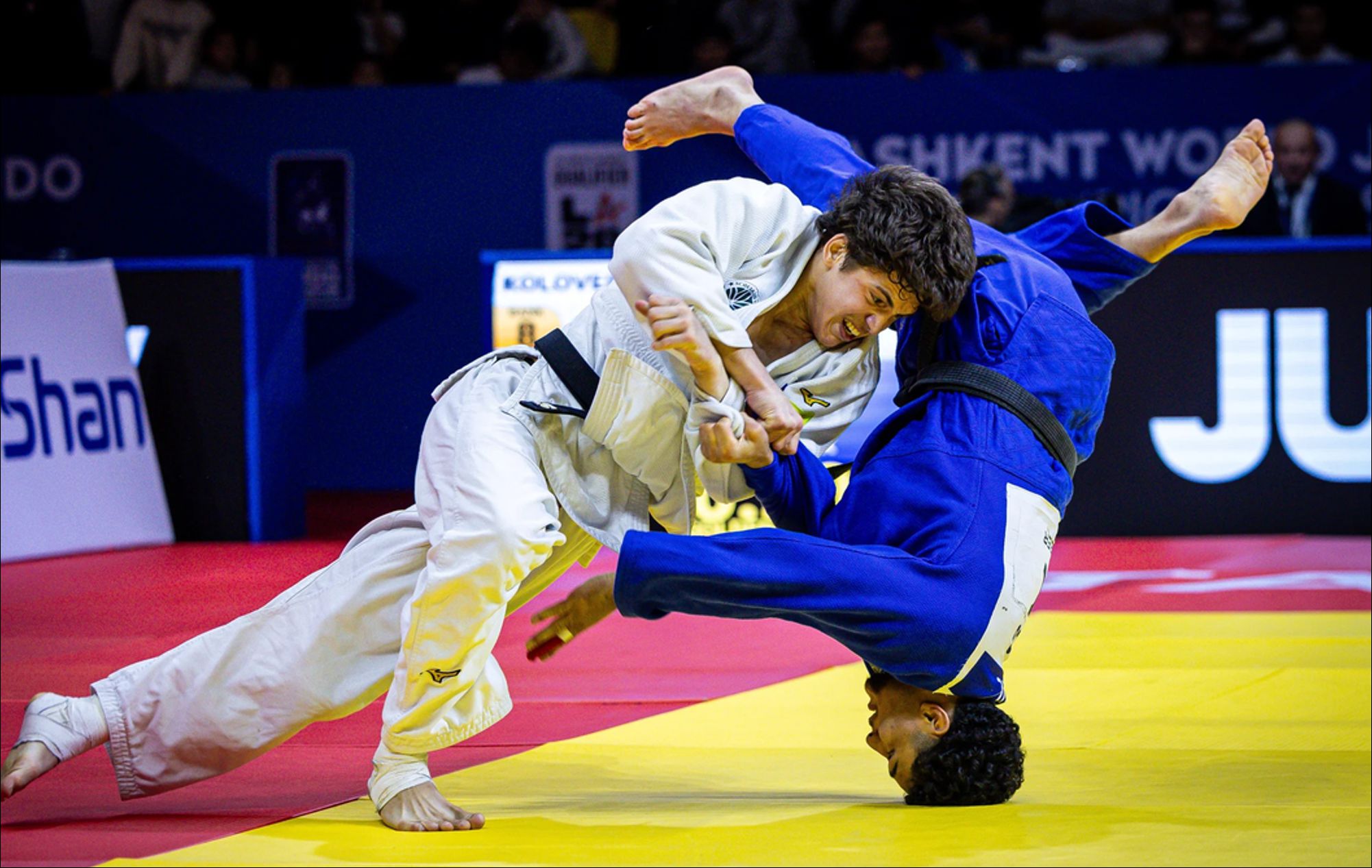
Pavel Koloverdov gives Russia their third gold with win over Oussama Abdelhak Hezil (Photo IJF)
The Russian Federation continued its impressive campaign at the World Junior Judo Championships in Tashkent, adding two more gold medals to its collection.
Aishat Alieva opened the final block with a convincing ippon victory in the -57 kg category before Iaroslav Bunakov produced one of the most dramatic moments of the day in the -81 kg final. After falling behind against home favourite Sadulla Ravshanov of Uzbekistan, Bunakov turned the contest around with a spectacular ippon, bringing the Uzbek crowd to silence.
France also celebrated a junior world title with Manon Agati-Alouache, who overcame Tsendbazar Mashbat in the final. Pavel Koloverdov added another gold for the Russian Federation in the -73 kg category after defeating Algeria’s Oussama Abdelhak Hezil, the first African finalist in Tashkent. Meanwhile Aleksandra Andric (SRB) crowned her campaign with gold in the penultimate category, improving on her silver medal from last year’s edition.
After two days of competition, the Russian leads the medal table comfortably with four gold medals, one silver and one bronze. Japan is second and Uzbekistan is third.
Andric upgrades silver to gold
The women’s -70kg final offered an all-European encounter as Balkan rivals Andrijana Sutovic of Mentenegro and Aleksandra Andric of Serbia faced one another for the world title. They were familiar with each other’s judo, setting the stage for an intriguing battle for the ultimate prize.
Eventually, Andric broke the deadlock with a yuko to take the lead. Just as the contest appeared to be reaching its conclusion, the Serbian athlete produced another decisive attack in the final second, scoring a waza-ari to seal the victory.
Having finished as a runner-up at last year’s edition, Andric went one step further in Tashkent, returning home as a world junior champion.
Andric shared her thoughts about her path to the top of the podium, “I feel really good and happy to finally win the gold medal. Last year, I lost in the final and had to settle for silver, so this victory means a lot to me. I finished fifth at my first world championships, then won silver and now I have become world champion. I know my opponent well, although we do not train together. The leg technique I used came naturally in the moment; I didn’t plan it, I simply followed my feeling.”
Agati-Alouache claims France’s first title in Tashkent
The gold medal women’s -63kg contest brought together two judoka ranked among the world’s top 10. Manon Agati-Alouache of France faced Tsendbazar Mashbat, who was aiming to secure the United Arab Emirates’ first-ever world junior title.
The final was a tactical affair. Agati-Alouache received an early shido after just a minute but neither finalist managed to establish a clear advantage over the other. The contest remained relatively measured, with few attacking opportunities. Eventually, however, the French judoka found the decisive moment to complete her technique and secure victory.
Agati-Alouache was crowned world junior champion, delivering France its first gold medal of the Tashkent championships.
“I am really happy because I have worked and trained so hard for this moment. Becoming a junior world champion is the result of all that hard work and it makes everything worthwhile. In the final, I was surprised myself when I managed to score just three seconds before the end. I had prepared myself for the possibility of golden score but I never gave up. I just went for it and trusted my judo,” said Agati-Alouache.
Koloverdov claims Russia’s third gold
The men’s -73kg final brought together Pavel Koloverdov of Russia and Oussama Abdelhak Hezil of Algeria, with the Algerian trailblazing as the first African finalist in Tashkent.
In the gold medal contest, Koloverdov opened with an attempted sasae-tsurikomi-ashi but the technique failed to produce a score. Subsequently, Hezil received a shido and with neither judoka able to settle the contest in normal time, the finalists moved into golden score.
The Algerian judoka collected a second penalty, increasing the pressure, before Koloverdov finally found the breakthrough with a waza-ari. The Russian judoka secured the gold medal, bringing the Russian Federation’s tally to three titles at the World Junior Championships 2026.
“This victory is the result of all my hard work and effort. It was a very tough final against an uncomfortable opponent who likes close, physical exchanges. When he received his second shido he became more aggressive but I knew I had to keep doing my job and adjust my approach when I got tired. Despite the intensity, there was mutual respect between us. Winning my first world championship gold medal is a huge step in my career. This competition means a lot to me and I am very proud of this achievement,” added the Russian junior world champion.
Bunakov silences the home crowd
The final contest of the day promised a spectacular conclusion as home favourite Sadulla Ravshanov of Uzbekistan faced Iaroslav Bunakov of Russia in the men’s -81kg category. With the Uzbek judoka hoping to delight the home supporters and add another title to the hosts’ collection the stage was set for an unforgettable finish.
The final was undoubtedly one of the most eagerly anticipated encounters of the day. As Ravshanov stepped onto the tatami the marching band returned and thousands of Uzbek supporters filled the Martial Arts Combat Arena with noise and enthusiasm. The opening two minutes were largely devoted to grip fighting as both finalists searched for the right opportunity to attack.
The contest then took an unexpected turn. Ravshanov found his rhythm and scored two yukos to put himself in a promising position. However Bunakov refused to surrender. The Russian finally established the grip he had been searching for and launched a spectacular attack that sent the home favourite flying for ippon.
The Uzbek crowd fell silent as Bunakov celebrated another Russian triumph. With this victory the Russian Federation secured its second pair of gold medals at these championships matching its achievement from the opening day and bringing the second day of competition to a dramatic close.
Bunakov shared his secret about his mindset during the final: “I am really happy because I managed to execute everything I had worked on and deliver when it mattered most. I focused on my own plan, regardless of the home crowd, and followed my coach’s advice whenever I needed to adjust. It was an intense, attacking fight with some risky situations, but I enjoy this kind of contest even more when I win! This gold medal is also a shared achievement with my childhood friends, and I dedicate it to everyone who has supported me throughout this journey. It is an incredible feeling!”