


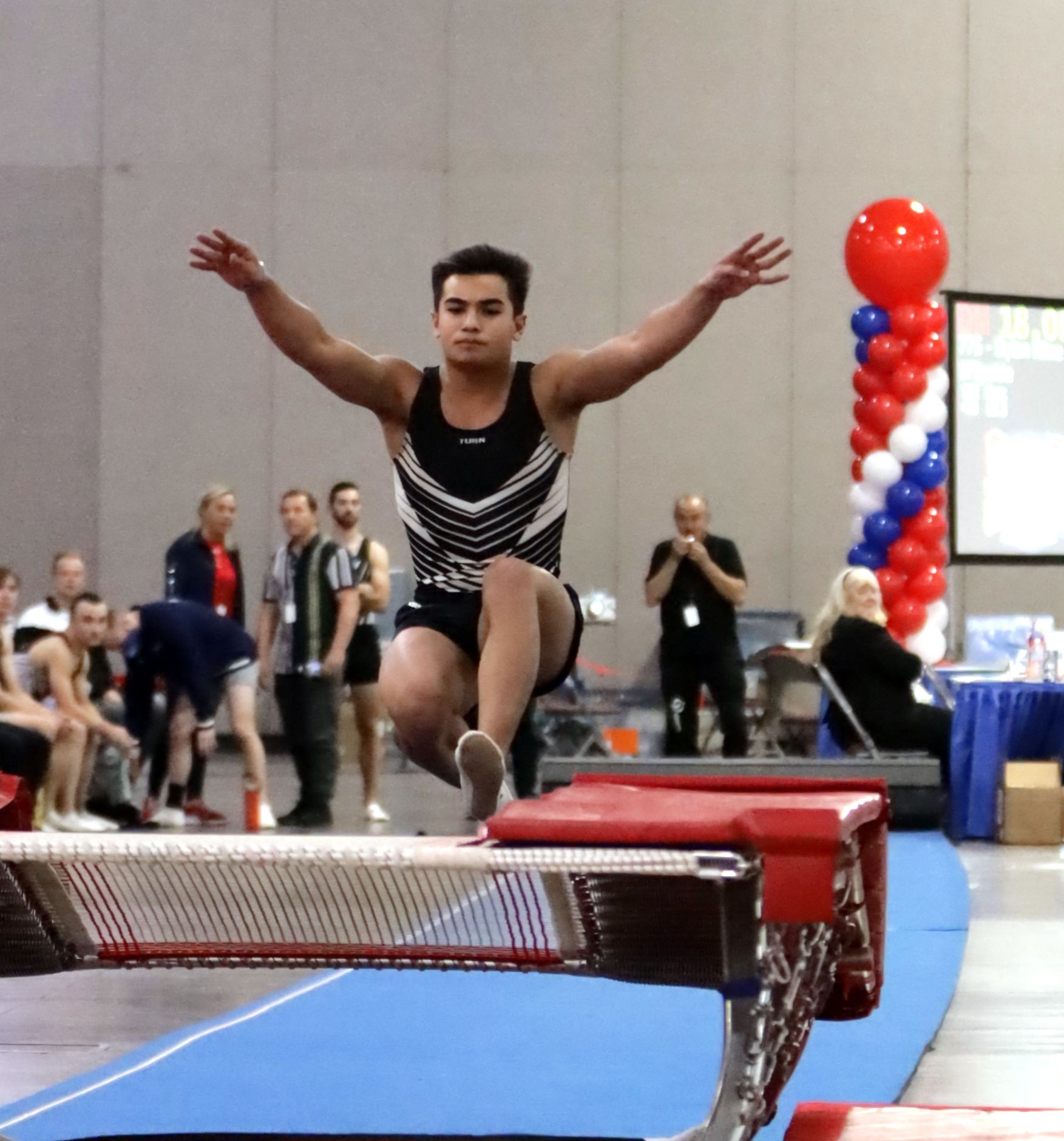
Ruben Padilla (Photo by Laul0005)
Ruben Padilla of the USA claimed his third consecutive world title in Double Mini-Trampoline in Pamplona, Spain, while Australian Ethan McGuiness and Spanish star Melania Rodriguez picked up their second in Men’s Tumbling and Women’s Double Mini-trampoline, respectively.
Neutral gymnast Arina Kaliandra won the Women’s Tumbling title after a thrilling showdown with 2023 World champion Candy Briere-Vetillard of France. The neutral athlete duo of Katsiaryna Yarshova and Stanislau Yaskevich made history as the first Mixed Synchronised Trampoline gold medallists.
In Trampoline team competition, the same trio that won gold for the People’s Republic of China defended in the women’s competition, while two groups of Independent Neutral Athletes claimed men’s gold and silver ahead of bronze medallist Portugal. Neutral athletes also won silver in the women’s team competition, ahead of Japan, handing team leader Mori Hikaru her 11th world medal.
Earlier this year Spaniard Melania Rodriguez became the first woman to land a triple pike dismount off the Double Mini-trampoline. On Saturday, she became the first woman to do it at a World Championships, and in the most important moment of the final.
Rodriguez was first of four gymnasts to perform in the one-pass “super final” that determines the medals. Jumping first meant she had no notion of what other competitors would do. So she went for broke with the double pike, despite not training it much in the leadup to the World Championships.
The gutsy decision paid off in gold, her second consecutive world title. Her victory unleashed a flurry of excitement in Spain, where her name was trending on X as of Saturday night.
“It’s crazy because it has been so long since I’ve done a triple pike, but I was super determined to land it on my feet, and I did!” Rodriguez said. “I know I celebrated a little too soon, because I took a lot of steps afterward, but I didn’t care anymore. I’d done my job and I was happy with it, and whatever colour the metal was, I didn’t care because I was so happy with what I’d done.”
Neutral athlete Galina Begin won silver, while Kirsty Way of Great Britain hit her difficult full in Rudi out mount in “the most important routine of her life” to land with bronze. From a decade of performing at the World Championships Way has gleaned nine medals, but Saturday’s bronze was her first as an individual.
Rodriguez dedicated her victory to her departed personal coach Pablo Hinojar, who passed away unexpectedly at the end of 2024. “Wherever he is, I’m sure he’s very happy,” she said.
Even a few weeks ago Australian Ethan McGuinness wasn’t sure if he would compete at the World Championships.
2025 had been a year to forget for the Australian tumbling star. There were injuries and uncertainties. His beloved dog died a few weeks ago. Frequent nosebleeds meant he had to stuff kleenex inside his left nostril just in case he started bleeding mid-run.
Small wonder then that as McGuiness stood at the head of the Tumbling track one rather simple pass away from reclaiming the World title he won in 2022, he wondered at the ways of the universe.
“I came into this competition with no confidence at all, and I’m a very confident person, but I’ve just had the worst preparation,” McGuiness said. “It’s just been so difficult to the point where I was going to withdraw. I didn’t say it out loud, but in my head I was really thinking of withdrawing, but my family had already booked their holiday, so I thought, I’ll give it a crack.”
Things began going his way in the semifinal, where McGuinness nailed his run to qualify atop the leaderboard. At the same time, reigning world champion Mikhail Malkin Azerbaijan and the his teammate the World Games medallist Tofig Aliyev were eliminated after mistakes. World Games champion Kaden Brown of the USA made it all the way to the four-person super final but stopped his last pass after underrotating a Miller (triple-twisting double layout).
That left Danish tumbling daredevils Magnus Lindholmer and Martin Abildgaard — and McGuinness as the last people standing.
After Abildgaard received a low score for his last pass and Brown fell, Lindholmer and McGuinness chose to play things safe. Lindholmer showed a clean pass that wouldn’t qualify as daredevil’s work at this level. McGuinness, the last to perform, followed suit, making sure his routine was just a bit harder than Lindholmer’s. Not a lot. Just enough.
It worked: 26.900 trumped Lindholmer’s 26.200, and suddenly McGuiness was a two-time world champion.
“Because I didn’t even know if I would even make it this far in the competition, I was trying to be very strategic this whole event: watch everyone else, do just what I need to do, not pushing my body because there’s a breaking point,” McGuinness said.
“Usually I would know that I had it. This time I thought, maybe there’s a possibility I won’t even make it through the first two skills. And I just had so many different routine options in my head. As soon as I started the runup I thought, you know what, I can get the gold. I did what I needed to do. My goal for this competition was just to make the semifinals. It’s better than that,” he added. “It means the world to me. It just means that I did all the right things, you know, all the sacrifice, pushing through all the pain, all the emotion, early mornings. It was worth the journey.”
Maybe 2025 hasn’t been so bad after all.
Candy Briere-Vetillard of France knew that her signature pass, combining a double layout, double tuck, and double pike, would be “decisive” in Friday’s Women’s Team Tumbling final.
She played the same card in the individual final Saturday with a similar variation of the run, and for a moment it seemed like gold would be hers. Then came neutral gymnast Arina Kaliandra, who showed almost the same pass, but sprinkled in a few well-placed whip backs to make it even more difficult.
Kaliandra’s 27.300 brought the 19-year-old gold at her first World Championships. Briere-Vetillard won silver with 27.000, while 17-year-old Lani Spiessens of Belgium upgraded to bronze after a fourth place finish at The World Games this summer.
“I’m so happy I did it today,” said Kaliandra, who credited travelling to World Cup competitions this summer as part of her success. “Before it wasn’t so perfect, but now I just feel so confident. It’s easier to me now.”
Yarshova and Yaskevich culminated a year of work by winning the first Mixed Synchronised Trampoline final held at a World Championships.
The new event is the first to be added to the Trampoline programme in more than a quarter century, and each of the eight pairs in the final had etched their names into the sport’s history before they even stepped onto the trampoline beds.
Yarshova and Yaskevich carried the day and earned their first world medals with an exercise that shows what makes Synchro so spectacular; jumping together, the two seemed like mirror images of each other. 51.310 gave them gold, edging Sakurai Ena and Miyano Hayato of Japan, who scored 51.080.
“We wanted to be a part of history. We were a bit nervous in the final because you only get one attempt,” Yaskevich said. “This is a great result for us because we knew from the beginning of the year that we could compete in this discipline. It was our aim to win this medal.”
The brother-sister pair Seljan Mahsudova and Magsud Mahsudov of Azerbaijan earned bronze, the first world medals for both.
As the final gymnast to compete in the Men’s Double Mini-trampoline final, Ruben Padilla knew he had options.
Go for broke with one of his risky gymternet-breaking passes or do what he knew he could land well? Padilla made the safe choice, going for a conservative-for-him triffis pike to half in, triple front pike half out. Which he stuck, because that’s what he does.
It was more than enough to put Padilla ahead of his old nemesis Mikhail Zalomin, the 11-time world champion who achieved Padilla-like levels of success in the 2010s. Saturday was the first time the two had met at a World Championships since 2021, and the reunion was a happy one. After the final scores were announced, the much taller Zalomin hoisted Padilla into the air. Padilla promptly returned the favour.
“I definitely played it safe,” laughed Padilla, who also competed in several semifinals in both DMT and Trampoline earlier Saturday. “I was pretty tired to say the least, so I just wanted to put two passes that I felt like I knew I could do. I went into it not knowing what was going to happen, it was such a strong field of athletes. I was just hoping to put two passes to my feet and whatever happened happened. I’m super happy to be taking home another gold medal.”
The talented 17-year-old American West Fowler, 17, earned bronze with a variation of the pass that Padilla used to win gold.
It was a good day to be a reigning world champion in Pamplona. An Olympic one, not so much.
Paris 2024 Trampoline gold medallists Ivan Litvinovich and Bryony Page of Great Britain were eliminated from Sunday’s individual Trampoline finals in two dramatic semifinal rounds that narrowed the field to eight ahead of Sunday’s medal round.
Litvinovich bounced off the Trampoline early in his semifinal, falling victim to the pressure of the one-and-done nature of the competition. Unlike the earlier qualifications, in the semifinal gymnasts do not get a second chance to record a good score.
Page completed her routine, her score was lower than usual due to an issue with her difficulty. Page and her coaching team appealed the score but the score ultimately went unchanged. Two-time World champion Yan Langyu of China, who won bronze at the Olympics, also fell short of his best work and ended in 20th place.
Paris silver medallist Viyaleta Bardzilouskaya, seventh, was eliminated by the two-per-country rule in finals, which also applies to neutral individuals. Olympic bronze medallist Sophiane Methot of Canada, 10th, grabbed the final place available.
With 58.030 points, veteran neutral athlete Iana Lebedeva was the strongest qualifier to the women’s final, while Paris silver medallist Wang Zisai of China scored 64.970 to lead the eight qualified to the men’s.