
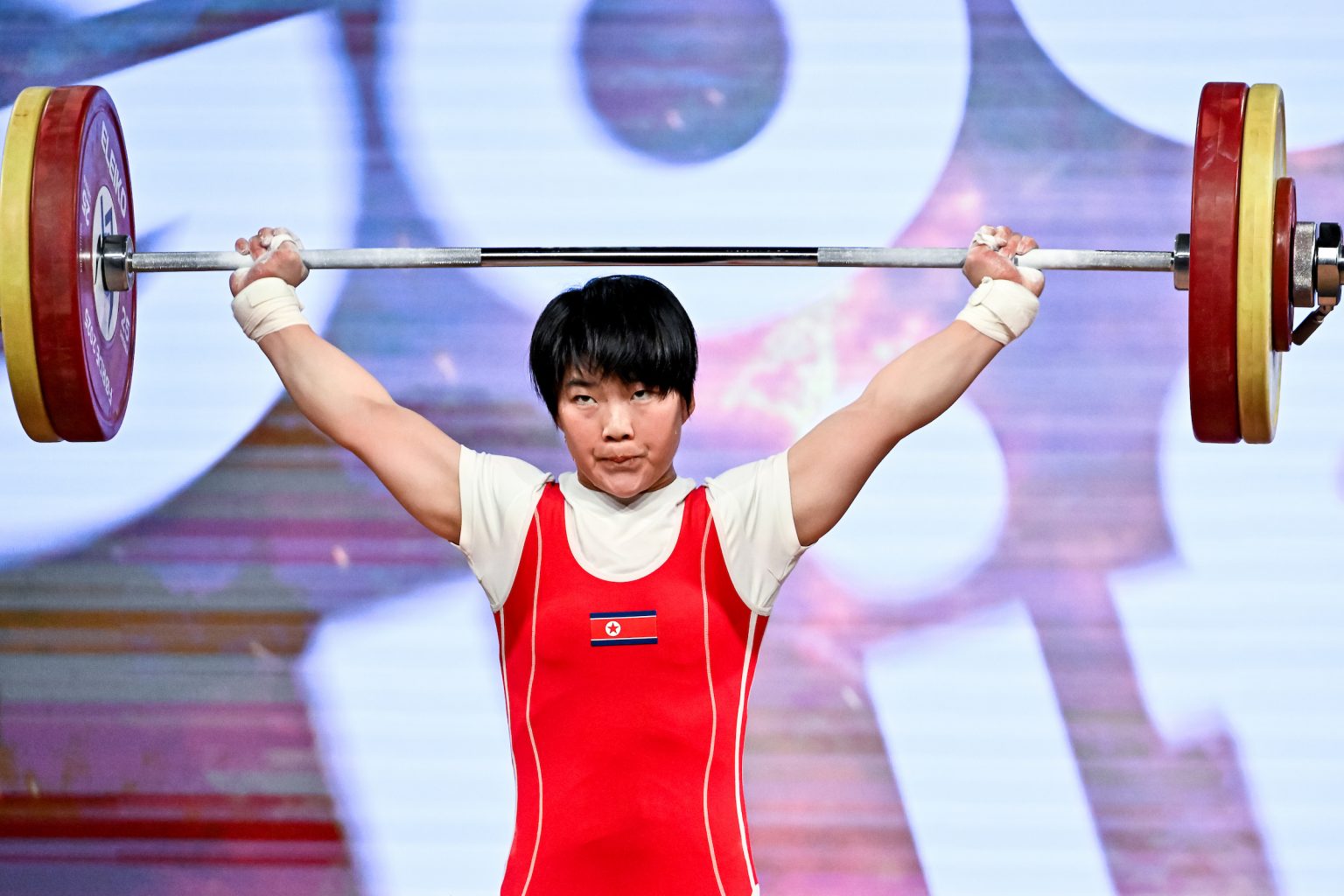
North Korean champion Ri Suk (Photo IWF)
The IWF World Wrestling Championships, from October 27 until November 8 in the Chinese city of Ningbo, is the first of 10 Olympic qualifying events. It has, as expected, attracted a formidable array of talent including 18 of the 19 athletes who set their senior world records in the past six months.
The most important weightlifting competition since the Paris 2024 Olympic Games will see more than 500 athletes set out on the path to Los Angeles 2028.
A few athletes have opted to skip Ningbo and start their qualifying programme at the second event, the IWF Qualifier in Qatar in early December. Among them are the Paris gold medallists Olivia Reeves from the United States and Solfrid Koanda from Norway.
Reeves and Koanda have had back injuries and another Paris winner, Rizki Juniansyah from Indonesia, is ineligible while he contests a provisional suspension for whereabouts failures.
Four of China’s 2024 winners have retired or been overtaken by younger athletes, so only three Paris champions are in the start book for Ningbo – Karlos Nasar, Liu Huanhua (in the B Group because he has also had fitness problems) and the triple super-heavyweight gold medallist Lasha Talakhadze, who has not competed internationally since Paris.
Arguably the biggest difference between now and the start of the last Olympic qualifying period is the presence of North Korea. Since returning to international competition in 2023 after a four-year Covid-related absence that kept them out of the Tokyo and Paris Olympic Games, North Korea has claimed more major titles and more world records than any other nation.
All but one of North Korea’s team of 13 in Ningbo will lift in an A Group and seven of them are world record holders. Two world champions, Ri Suk and Song Kuk-Hyang, compete against each other at 69kg after Ri Suk moved up in weight. China is not contesting the 69kg category, which has 48 entries in four sessions.
China, like the United States, Russia and Chinese Taipei, has a maximum team of 16. The host nation has 15 in A Groups, the US nine, Russia six and Chinese Taipei five. Iran, which has had a successful year to date, has eight of its 11-strong team in A Groups, and Armenia has six of 13.
One of China’s biggest hopes for the future, 19-year-old Yang Liuyue, set snatch and total world records at the recent Asian Games at 61kg. She predicted a clean and jerk world record to complete the set in Ningbo.
Li Yan is a strong home favourite in the women’s super-heavyweights, where Ikhlef Ouisal from Qatar and Marifelix Sarria from Cuba are improvers to watch.
The men’s super-heavyweights could be one of the closest and most exciting contests. The top three at the Asian Games renew rivalry – Ali Davoudi from Iran and Ali Ammar Yusur from Iraq, whose totals were 466kg and 465kg respectively, and Gor Minasyan from Bahrain. They will be joined by Davoudi’s team-mate Alireza Yousefi and the European champion Varazdat Lalayan from Armenia, as well as Lasha.
Rahmat Erwin from Indonesia tops the entry totals at 75kg after setting two world records at the Asian Games.
The 85kg category is exceptionally strong, with 44 entries in four groups and a long list of medal contenders. Yeison Lopez from Colombia has the highest entry total and can expect to be pushed by athletes from North Korea, China, Kazakhstan, Iran, Egypt and Moldova.
There are also four sessions at 95kg, where Karlos Nasar is favourite. At 110kg, Akbar Djuraev from Uzbekistan is expected to win his fourth world title.
Athletes must compete in a minimum of five of the ten qualifying competitions to earn a ranking for LA2028. The calendar is split into Period One (six events, three totals needed) and Period Two (four events, two totals needed). The competitions in Period One begin in Ningbo and end with the 2027 World Championships next September. The Period Two events run from November 2027 until May 2028.