


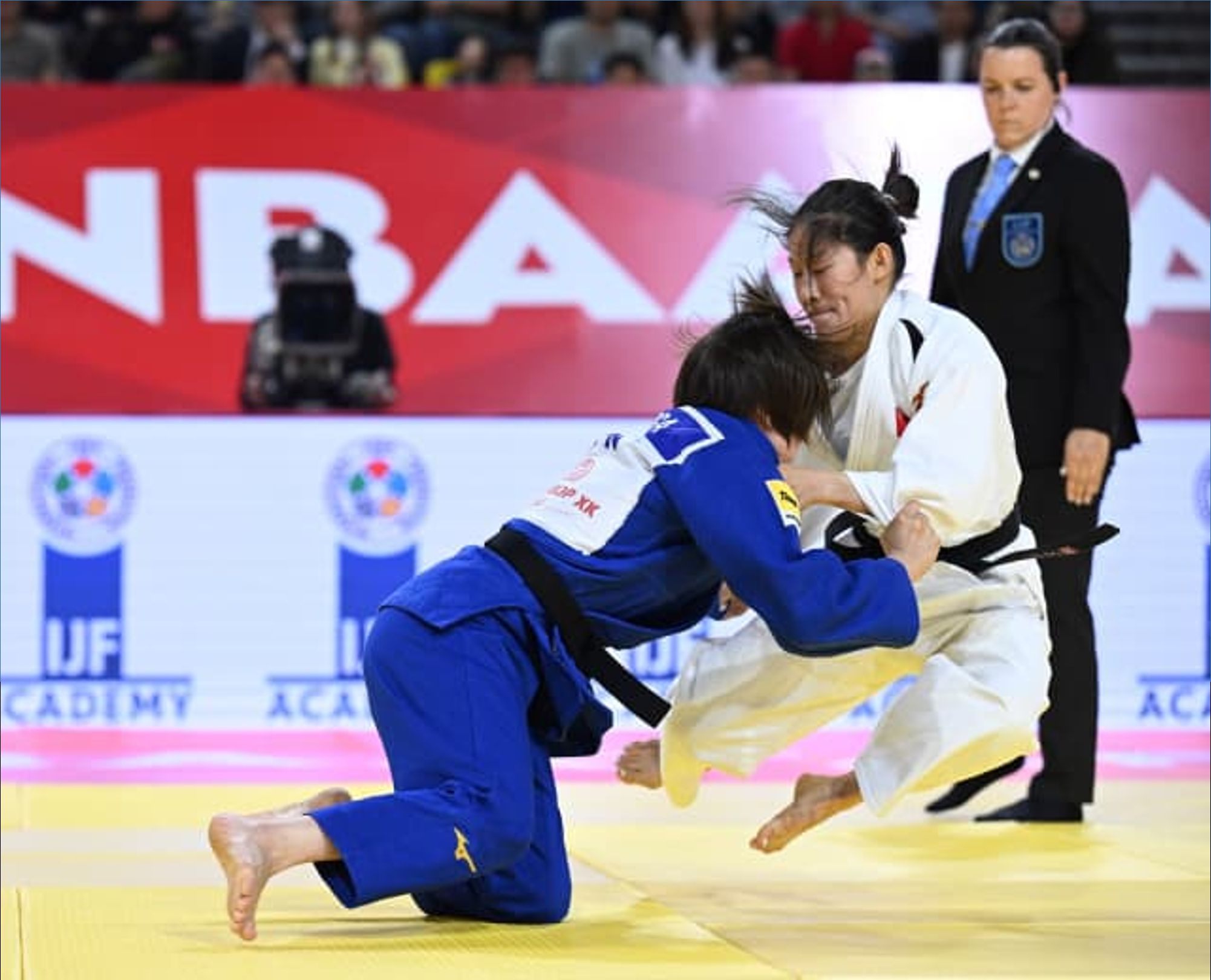
Wenna Zhuang of China and Wakana Koga of Japan (Photo IJF)
Shirine Boukli of France arrived in Mongolia full of confidence after an impressive start to the season having claimed two major women’s -48kg titles: the Paris Grand Slam on home soil in February and the European Championships in Georgia in April. For the world and Olympic medallist who entered the competition as the number one seed, the opening round against Galiya Tynbayeva Kazakhstan was an opportunity to find her rhythm.
From the very beginning, however, Boukli appeared to be struggling to impose her usual pace. She needed a long golden score period to finally overcome Tynbayeva, scoring a narrow yuko.
In the next round, she faced Belgium’s Lois Petit, who had little experience at grand slam level but arrived with strong credentials as a two-time junior world medallist. Once again, Boukli was unable to raise the intensity and a second consecutive golden score proved fatal, as Petit secured a significant victory.
On paper, Sabina Giliazova of Russia seemed to be among the strongest contenders for a place in the semi-final but it was another outsider, Wenna Zhuang of China, who upset predictions. She advanced to face Petit in the semi-final, where she delivered a dominant performance to secure victory by ippon.
The second half of the draw was equally challenging for the favourites. Both Anudari Jamsran of Mongolia and Laura Martinez Abelenda of Spain were eliminated, leaving Wakana Koga of Japan to progress to the final. Koga arrived in Ulaanbaatar with solid credentials, having won the Tokyo Grand Slam at the end of 2025 and claiming a bronze medal at the Paris Grand Slam earlier this season.
The final therefore brought together Wenna Zhuang of China and Wakana Koga of Japan, both athletes having produced a series of impressive performances through the day. Koga was the first to make her move, taking the lead with an early yuko within the opening seconds of the contest. With just under a minute remaining, she doubled her advantage, controlling the final perfectly and ultimately claiming the gold medal.
Koga declared, “Since this tournament serves as a pathway to the world judo championships for us, I am incredibly happy to have won here. After watching my opponent’s contests today, I knew she was a very powerful athlete. To ensure I wasn’t overwhelmed by her strength and momentum, I stayed focused, stuck strictly to my grips and fought hard. Because this tournament awards crucial Olympic qualification points, I was determined to achieve the best result possible here and I will carry that same drive into the next tournaments as I take on the challenging path all the way to the Olympics.”
There was tremendous depth in the men’s -60 kg category, which featured world medallists, world champions such as Ryuju Nagayama of Japan, and Olympic medallists, including Luka Mkheidze of France. However, not all of them experienced the same fate at this opening tournament of the Olympic qualification period.
The draw suggested an exciting third-round clash between Nagayama and Mkheidze but the French athlete’s journey came to an unfortunate end before that could happen. He was stopped in his opening contest by Ruslan Poltoratskii of Bahrain, who produced one of the early surprises of the day.
The path opened up for Nagayama who, with his characteristic approach of appearing as if he was not competing but simply enjoying high-level randori, advanced steadily towards the final. His journey was not without challenges, particularly against Sukhbat Byambasuren of Mongolia, who, backed by his home crowd, showed that he feared nobody and was ready to challenge one of the greatest names in the category.
On the upper half of the draw, the situation was more straightforward. The day’s favourite, Balabay Aghayev of Azerbaijan, confirmed his status with a series of convincing performances to book his place in the final.
The gold medal contest therefore brought together two athletes in excellent form, Balabay Aghayev and Ryuju Nagayama, each expressing a different style of judo. Entering the final with the same relaxed attitude and explosive ability to throw, but also with the willingness to take risks that can sometimes leave him exposed, Nagayama soon found himself trailing by a yuko after Aghayev scored with sumi-gaeshi.
Increasing the pressure, the Japanese athlete also received two penalties, putting himself in a difficult situation against the tactical intelligence of Aghayev. The Azerbaijani judoka, despite receiving a penalty himself, managed the final perfectly to preserve his advantage and claim a superb gold medal.
Balabay Aghayev explained, “It was an incredible way to begin the Olympic qualification period, especially since I was able to avenge past losses against world champions. My coach and I really did our homework, analysing my previous mistakes. Their styles are very classic and calm; our Azerbaijani judo is much more emotional which makes it very difficult for them to handle. Looking ahead, having the world championships at home in Baku isn’t a pressure, it’s an extra motivation for me, my family and our supporters. Our team is like a tight-knit family and when someone struggles, we remind them of Baku because our goal isn’t just to have one world champion, but several champions on home soil.
There were seeds everywhere in the women’s -52 kg category, many of them arriving in Mongolia after spectacular starts to the season. There were, of course, outsiders waiting for their opportunity to fight their way towards the medals too. But above all, there was Uta Abe; only Uta Abe and nothing but Uta Abe. Such was the impression left by the five-time world champion and Tokyo 2020 Olympic champion, who appeared to be operating on a different level from everyone else.
Untouchable, unstoppable and unshakeable; all these words could describe the performance of the Japanese star, who once again demonstrated her extraordinary power, precision and technical mastery.
One had to witness the way Abe flew through the preliminary rounds to fully appreciate her dominance. Her opponent in the final, Italy’s Odette Giuffrida, was unfortunately forced to withdraw due to injury, leaving the gold medal, almost inevitably, in the hands of Uta Abe, her twelfth gold medal in a grand slam, a new record for a women at the grand slam level.
Troubled by an injured arm, Giuffrida nevertheless produced an exceptional performance to reach the final. Fighting effectively with only one arm, she overcame world championship bronze medallist Roza Gyertyas of Hungary, who therefore joined her teammate Reka Pupp in a contest for a bronze medal. The experienced Pupp ultimately claimed the medal with a superb uchi-mata scoring waza-ari.
Uta Abe said, “It had been about half a year since my last match, so I was a little nervous. However, I managed to get my feel for the contest back and it turned out to be a good performance. We were able to secure Olympic qualification points while winning the tournament. I think we made a good start towards the Los Angeles Olympics. My next competition will be the World Judo Championships in Baku and I will work hard to win there.”
The men’s -66 kg category delivered its share of explosive and spectacular judo, with each athlete eager to impose his own style and leave his mark on the competition.
At the very top of the draw, world number three Ruslan Pashayev of Azerbaijan, a bronze medallist in Paris and the category winner in Austria earlier this season, had a great opportunity to strengthen his position on the World Ranking List.
Everything went according to plan until the quarter-final, where he encountered the impressive Ramazan Abdulaev of Russia, whose mastery in ne-waza proved decisive. Indeed, the Russian judoka reached this stage of the competition having won all of his contests on the ground, whether by armlock or hold-down. It was another reminder that ne-waza remains a fundamental element of judo. Even when trailing on the scoreboard, Abdulaev always found the resources and technical solutions necessary to turn the situation around.
Carrying that momentum into the semi-final, he overcame David Garcia Torne of Spain, who until then had looked almost untouchable during the morning session.
On the opposite half of the draw, world number four Takeshi Takeoka of Japan confirmed his status as one of the favourites. He put together a series of convincing victories, including a semi-final win over Nizami Imranov of Azerbaijan. Throughout the day, Japan once again demonstrated that this first Olympic qualification tournament was a milestone they had no intention of missing on the road to Los Angeles 2028.
The final therefore brought together two athletes in outstanding form: Ramazan Abdulaev of Russia and Takeshi Takeoka of Japan. Firmly planted on his feet and perfectly in control of his movement, Takeoka was the first to make a difference, using a perfectly timed kata-guruma that caught Abdulaev by surprise. At no moment did the Russian judoka appear capable of turning the tide or even creating the conditions for a truly dangerous attack. With great tactical maturity, the reigning world champion Takeshi Takeoka secured the gold medal comfortably.
Takeshi Takeoka said, “Heading towards my first Olympics, I know international opponents have researched my style, so I must continuously grow and defeat them one by one. This is especially true for the Baku World Championships; since I won last year and now wear the red backnumber. Everyone is targeting me, so my main goal is to secure a second consecutive world title. In today’s final, I wanted to fully showcase my greatest strength, constantly stepping forward and staying on the attack. Ultimately, the biggest factor in my victory was winning that mental battle, refusing to lose to myself and keeping my determination strong.”
Fresh from winning her recent women’s -57kg European medal, Timna Nelson Levy of Israel arrived in Ulaanbaatar with the confidence expected of the number one seed. A convincing opening victory against Italy’s Veronica Toniolo gave her access to a quarter-final, which she began with assurance. However, she came up against the determination of Maysa Pardayeva of Turkmenistan, who left no room for doubt, throwing Nelson Levy in less than a minute with a powerful ko-soto-gari for ippon; a masterpiece of efficiency. Unfortunately for Pardayeva though, her impressive run was halted by Japan’s Akari Omori who, following the example set by her teammates throughout the day, continued her path to the final.
The second half of the draw offered another fascinating storyline with the rivalry between two French judoka, Faiza Mokdar and Sarah Léonie Cysique. On one side was the rising generation represented by Mokdar; on the other, the experience and maturity of Cysique. The battle from a distance ultimately went in favour of experience, as Cysique secured her place in the final without having to face her younger compatriot, who was eliminated in the quarter-finals.
The final therefore featured Akari Omori of Japan against Sarah Léonie Cysique of France, an exact remake of the Paris Grand Slam final in February, which went in favour of the French judoka.
Nearly three minutes passed before the first penalties were awarded, one to each athlete for passivity, illustrating just how balanced the contest was. However, in a transition phase that seemed to be heading into ne-waza, Omori took advantage of a brief moment of relaxation from her opponent to turn her over and score an undeniable ippon. It was another gold medal for Japan on a remarkable opening day of competition.
After the final, Akari Omori said, “While I am taking a moment to savour this victory in Ulaanbaatar, I know I still have areas to work on. The key to my success today was reflecting on my performance at a competition in Japan just last week; I spent the last seven days fixing my mistakes, developing specific strategies and training hard to bridge the gap that comes with competing abroad. Looking ahead, nothing is scheduled next just yet but if I am given the opportunity to compete in another grand slam before the world championships, I want to take it, win another title and carry that momentum into the worlds to aim for gold.”