


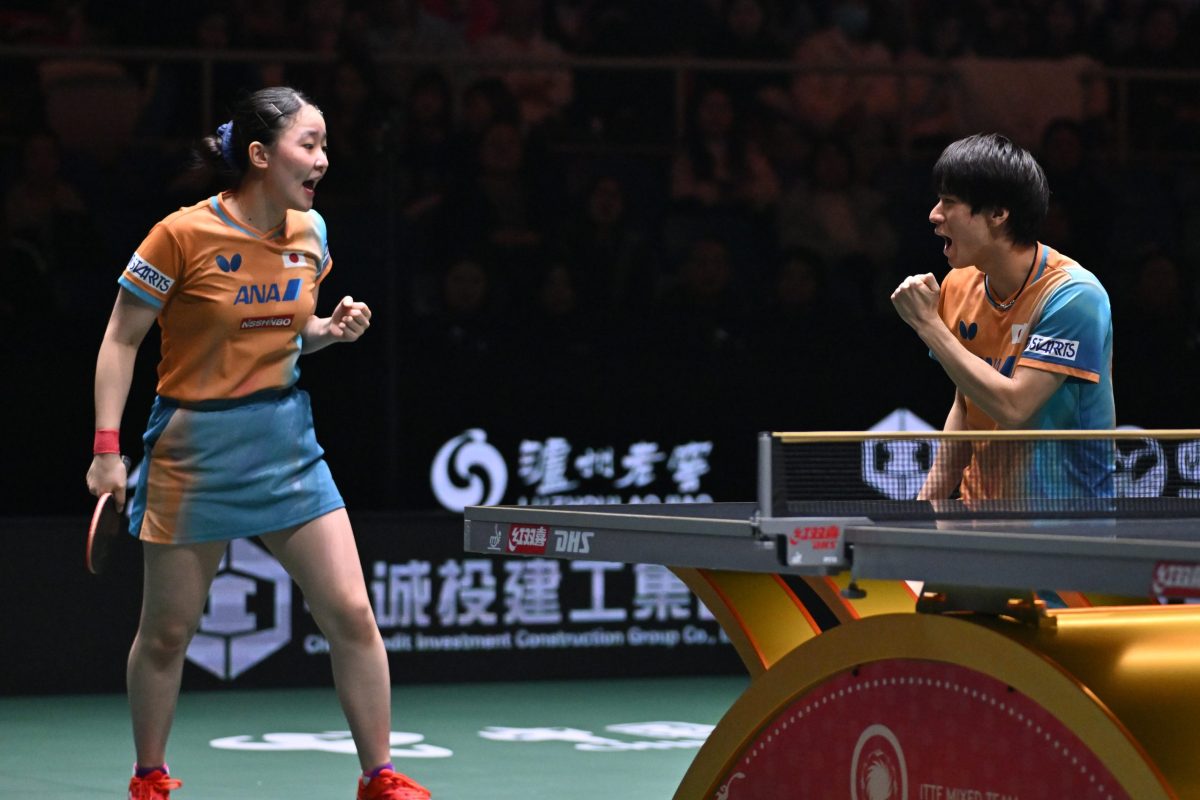
Miwa Harimoto and Shunsuke Togami swept past the inexperienced duo of Yashaswini Ghorpade and debutant Akash Pal
Japan survived a mighty scare from India to win 8-4 at the ITTF Mixed Team World Cup in Chengdu.
The opening mixed doubles unfolded as Miwa Harimoto-Shunsuke Togami swept past the inexperienced duo of Yashaswini Ghorpade-debutant Akash Pal in straight games.
Yet, despite the 0-3 loss, Pal left his mark. His shot-making drew gasps from the crowd, with exquisite backhand flicks, and booming forehand topspin shots away from the table showcasing his raw talent.
With a 3-0 lead in place, Japan’s Mima Ito took on India’s Manika Batra in a high-profile women’s singles clash. Mima took the opening game 11-9, opening up a comfortable 4-0 lead for Japan, with things looking grim for India.
But a determined Batra dug into seemingly impossible reserves of shot-making to claw her way back. From the second game onwards, her strategy clicked. She used pace changes from her ‘long pimple’ backhand rubber to great effect, repeatedly exploiting targeting Ito’s short forehand side, mercilessly exploiting the lack of back-swing on her forehand.
Mixing backspin and float balls, she disrupted the timing on the flat forehand hits preferred by Ito. The plan worked. Batra captured the next two games to seal a 2-1 victory. The triumph was extra special, as it marked her first ever win over Ito in seven encounters.
With India trailing 2-4, an inspired Manav Thakkar stepped up against Japanese wonder-kid Sora Matsushima, who had been picked over World No. 5 Tomokazu Harimoto in the men’s singles. Normally a counter-attacker, Thakkar stunned Matsushima by taking the initiative.
He used his step-around forehand to target Matsushima’s backhand and was lightning quick across the table. Thakkar cleverly turned Matsushima’s speed against him, forcing the Japanese to generate power, and then using that same pace to push him away from the table.
A crucial timeout at 10-9 in the first game gave Thakkar the edge, and he converted it into a 1-0 lead. Riding that confidence, he dominated the second game win it 11-4 and level the tie at 4-4 for India. Matsushima regrouped in the third, finding his rhythm to take the game. It was little more than consolation, but it secured a valuable point for Japan.
With a 5-4 lead, Japan pressed their advantage in the women’s doubles. Mima Ito and Hina Hayata wasted no time, sweeping Yashaswini Ghorpade and Diya Chitale in three straight games. India’s spirited fightback ended rather tamely, undone by their lack of doubles specialisation. A jubilant Japan sealed an 8-4 victory and booked their place in Stage 2 of the tournament.
Hong Kong, China registered their first win of the tournament with an 8-2 victory over Chile. They fielded a different pair in the opening mixed doubles fixture, picking Baldwin Chan-Zhu Chengzhu.
Senior teammates Wong Chun Ting and Doo Hoi Kem were picked for the singles fixtures. Chan-Chengzhu faced Gustavo Gomez-Daniella Ortega in a contest that proved closer than expected, but the duo held firm to take the match 2-1.
Doo Hoi Kem then carried the momentum into the women’s singles, defeating Paulina Vega in straight games. Vega’s unusual loopy forehand, which generated heavy topspin, unsettled Doo early on. The experienced paddler adjusted and edged the first game 12-10. From there, it was smooth sailing as she closed out the next two games comfortably.
In the men’s singles, Wong Chun Ting had to battle hard against Chile’s Nicolas Burgos. He dropped the opening game and soon found himself repeatedly drawn away from the table. An impressive Burgos mixed slow paced balls with sharp attacks to the backhand, effectively neutralizing Wong’s powerful forehand. But Wong relied on his experience, figuring out ways to extend rallies and forcing mistakes from the inexperienced Chilean. In the end, he clinched the decider 11-8 to win 2-1.
With Hong Kong, China leading 7-2, the World No. 1 men’s doubles pairing of Baldwin Chan-Wong Chun Ting stepped in to close out the match. They required only a single game to overcome Gustavo Gomez and Nicolas Burgos, sealing the fixture and completing a commanding 8-2 triumph.
Meanwhile, fan favourites and top seeds China delivered a blistering performance, sweeping Egypt 8-0.
The World No. 1 pairing of Kuai Man-Lin Shidong set the tone early, dispatching Marwa Alhodaby- Badr Mostafa in three straight games and paving the way for the singles.
World No. 1 Sun Yingsha then stepped in for her women’s singles match against Mariam Alhodaby. It was another 3-0 win for the Chinese star, despite Alhodaby pushing hard in the second game. The Chinese star denied Alhodaby the chance to convert her game-point opportunities in the second, edging it 14-12, before wrapping up the third swiftly.
With China already 6-0 ahead, World No. 1 Wang Chuqin closed the contest in style. He dispatched fellow southpaw Youssef Abdelaziz in the men’s singles in two quick games, completing the clean sweep and securing China’s place in Stage 2 of the tournament.
The competition also lit up with German brilliance as they toppled France 8-4. It was advantage France at the start, as Alexis Lebrun-Jia Nan Yuan combined to win 2-1 against Patrick Franziska-Annett Kaufmann winning. They won 12-10 in the deciding game to give France an early lead.
However, all the hard work of Lebrun and Yuan was undone as Prithika Pavade was unable to find her rhythm in the women’s singles against Germany’s Sabine Winter, who produced an assured and tactical performance. Making effective use of her ‘anti-spin’ backhand rubber to create openings for her forehand, Winter kept consistent pressure on the young French star. Pavade started positively but made a string of poor choices, disrupting her own rhythm and allowing Germany 3 valuable points and a surge of momentum.
With Germany leading 4–2, Benedikt Duda stepped in for the men’s Singles and raised the level. After a tight opening game that Lebrun edged 13–11, Duda responded with composure, taking the next two 11–9 against the French penholder. It marked his first win over Lebrun this year, after three previous meetings, and came at an important moment for Germany.
Now leading 6-3, Germany sealed the contest. Benedikt Duda was once again at the forefront, teaming up with Dang Qiu in the Men’s doubles. They overturned a first-game loss against Felix and Alexis Lebrun, to clinch the decider at 12-10, winning 2-1. That result not only secured Germany’s 8-4 triumph, but also marked Duda and Qiu’s first win as a pair over the French duo, after two defeats earlier this year.
With thes win, Germany sealed their spot in Stage 2 of the tournament.
Romania opened the evening session in style, powering past Brazil 8–2 to secure their first victory of the tournament.
In the opening mixed doubles fixture, the experienced Romanian duo Bernadette Szocs-Ovidiu Ionescu flew out of the blocks, conceding just nine points in the opening two games to surge 2–0 ahead of Felipe Arado-Karina Shiray. But to the surprise of everyone, Arado-Shiray managed to win the third game, and earn Brazil’s first point of the tournament.
With Romania leading 2-1, Andreea Dragoman stepped into the spotlight, making her first appearance in the women’s singles in this tournament. Facing Brazilian penholder Victoria Strassburger, she raced through the opening two games with ease. The third proved trickier, as she trailed 9-10. But Dragoman held her composure, saving game point and clinching it 14-12. Her straight-games victory extended Romania’s advantage to 5-1.
Southpaw Darius Movileanu kept Romania rolling, outlasting Brazil’s 16-year-old Lucas Romanski 2-1. Though defeated, Romanski impressed with the maturity of his gameplay, and is surely a talent Brazil will look to nurture as a future mainstay.
Then came the finishing touch, as Bernadette Szocs and Elizabeta Samara combined to clinch the opening game of the women’s doubles against Victoria Strassburger and Karina Shiray. That single victory sealed Romania’s dominating 8-2 triumph.
Croatia ensured their winning run stayed intact as they brushed aside Australia with an emphatic 8-3 victory.
Ivor Ban-Hana Arapovic continued their strong form in the mixed doubles, sweeping Finn Luu-Jiamuwa Wu in three straight games. The contest was far from routine, with Luu producing inspired play and daring shot selection that often paid off. Yet Ban looks to be operating on a different level in this tournament.
His monstrous backhands arrived whenever Croatia needed a point, and he repeatedly created opportunities out of nothing. The result was a commanding 3-0 scoreline that set the tone for Croatia.
Australia clawed back momentum in the women’s singles, as Yangzi Liu edged Croatia’s Lea Rakovac 2-1. A gruelling 3-game battle, the match was defined by long and slow-paced rallies between two evenly matched players. Rakovac looked in control early, taking the first game 13-11 and leading in the second. But Liu refused to yield, holding on to snatch the second 12-10. In a nail-biting decider, she won the mental battle, winning 13-11 to secure Australia’s first victory of the tournament.
Despite the setback in the women’s singles, Croatia still held a 4-2 lead. Tomislav Pucar extended that advantage, continuing his winning streak in this tournament by taking the first two games against Hwan Bae. Pucar dominated the exchanges, dictating tempo and forcing errors.
Yet the Australian youngster showed flashes of his potential. His fearless attitude won over the crowd, and riding their support, he battled back to claim the third game. The fightback was not enough to change the outcome, but it earned Australia a crucial point. With Croatia leading 6-3, the Men’s doubles became the clincher.
Ivor Ban-Frane Kojic delivered in style, defeating Hwan Bae-Finn Luu in two straightforward games. Kojic played the perfect supporting role, steady and reliable, while Ban once again unleashed his fury. Every weak ball was punished, as Croatia’s pair decimated opportunities and sealed the win.
With this win, Croatia’s remarkable journey continues in this tournament. Despite being the lowest-ranked team in the draw, they have already toppled eighth India and ninth seeded Australia. They have now qualified for Stage 2, and will be eager to sustain this momentum as the tournament progresses.
Korea Republic roared back from the brink, rallying from 0-4 to beat Chinese Taipei 8-6 in what was an instant classic.
Chinese Taipei leaned on the tactical freedom offered by the Mixed Team format, entrusting stars Lin Yun-Ju and Cheng I-Ching with doubles duties while giving their younger talents the singles spotlight.
Chinese Taipei’s tactical blueprint paid off immediately as their World No. 7 mixed doubles duo Lin Yun-Ju-Cheng I-Ching outlasted Korea’s Park Ganghyeon-Kim Nayeong in three nail-biting games. Despite the 3-0 scoreline, every set was a cliffhanger, with the former winning 12-10, 11-9, 11-9 in the three games, all by the barest margins possible, giving their team a vital 3-0 opening lead.
The onslaught from Chinese Taipei continued. World No. 52 Li Yu-Jhun made a brilliant start in the women’s singles, taking the first game 11-7 against World No. 12 Shin Yubin. That victory pushed Chinese Taipei into a 4-0 lead, as a shell-shocked Korea Republic bench looked on.
However, Shin regrouped well, igniting the Korea Republic’s fightback into the fixture by winning the next two games. Although visibly under pressure, she kept her composure, especially in the decider to win 11-9, and get two vital points on the board for Korea Republic.
Jang Woojin continued Korea Republic’s comeback into the tie, winning 2-1 in a high-quality match against a dangerous Lin Yen-Chun, who looked a transformed player since his loss to USA’s Sid Naresh the day before.
Despite being significantly lower in the rankings compared to Jang, Lin matched him shot for shot, with both players engaged in a match full of muscular showmanship. In the deciding game, Jang leaned on all his experience. At 10-9, he unleashed a surprise fast long serve to Lin’s backhand. The gamble paid off, catching Lin off guard and forcing a costly error at match point.
Chinese Taipei led 5-4 heading into the women’s doubles, where Huang Yu-Chiao and Li Yu-Jhun faced Korea Republic’s Kim Nayeong and Choi Hyojoo. Huang and Li pushed hard, but the Korean duo held firm. Despite appearing vulnerable, Kim and Choi soaked up the pressure, and their resilience exposed the inexperience of the Taipei duo, who faltered with unforced errors at crucial moments. The errors proved costly, as Korea clinched the match 2-1. With the tie locked at 6-6, the stage was set for a decisive men’s doubles showdown.
Chinese Taipei still fancied their chances. Their initial strategy had always hinged on taking the match deep into the men’s doubles, to allow the ‘Silent Assassin’ Lin Yun-Ju, to step into the spotlight and seal the win.
Lin and partner Kao Cheng-Jui stepped up against Korea Republic’s Park Ganghyeon and Oh Junsung. But Oh’s acrobatic doubles play stole the spotlight. Flying around the table, he produced forehand topspin winners that seemed impossible. The pressure told on Lin and Kao, who faltered at key moments. Korea closed out both games 11-9, sealing the win and completing the comeback.
With the 8-6 win, Korea Republic sealed a spot in Stage 2, and look prepared and dangerous.
Sweden’s strength proved overwhelming as they brushed aside a young USA team, notching the second 8-0 victory of the event.
In the opening mixed doubles fixture, Kristian Karlsson and Christina Kallberg survived a nervy 12-10 opening game against USA’s Liang Jishan and teenager Sally Moyland, but once across the line, the Swedish duo surged through the next two games to secure a 3-0 victory.
Up next for Sweden was Linda Bergström in the women’s singles, facing Jessica Lai Reyes. Bergström handled the challenge of Reyes’s short-pimple backhand rubber, a style notoriously difficult for a chopper to counter, with smart tactics. From the outset, she steered play away from Reyes’s backhand, and when she did engage there, she looked for attacking chances to exploit the slower pace and lack of topspin. Reyes found openings in the third game and briefly held a two-point lead, but Bergström quickly shut the door, regaining control to seal the match 3-0 and extend Sweden’s overall lead to 6-0.
In the men’s singles, the USA sprang a surprise as World Number 227 Xiangjing Zhang turned out for them instead of Sid Naresh, who is ranked more than a 100 places higher, in what eventually turned out to be the final fixture of the match. Taking on Anton Kallberg, Zhang unsurprisingly looked completely out of depth, with the World Number 32 Swede unleashing a dazzling array of topspin shots, losing only 6 points in two games to finish the clean sweep at 8-0 for Sweden.