


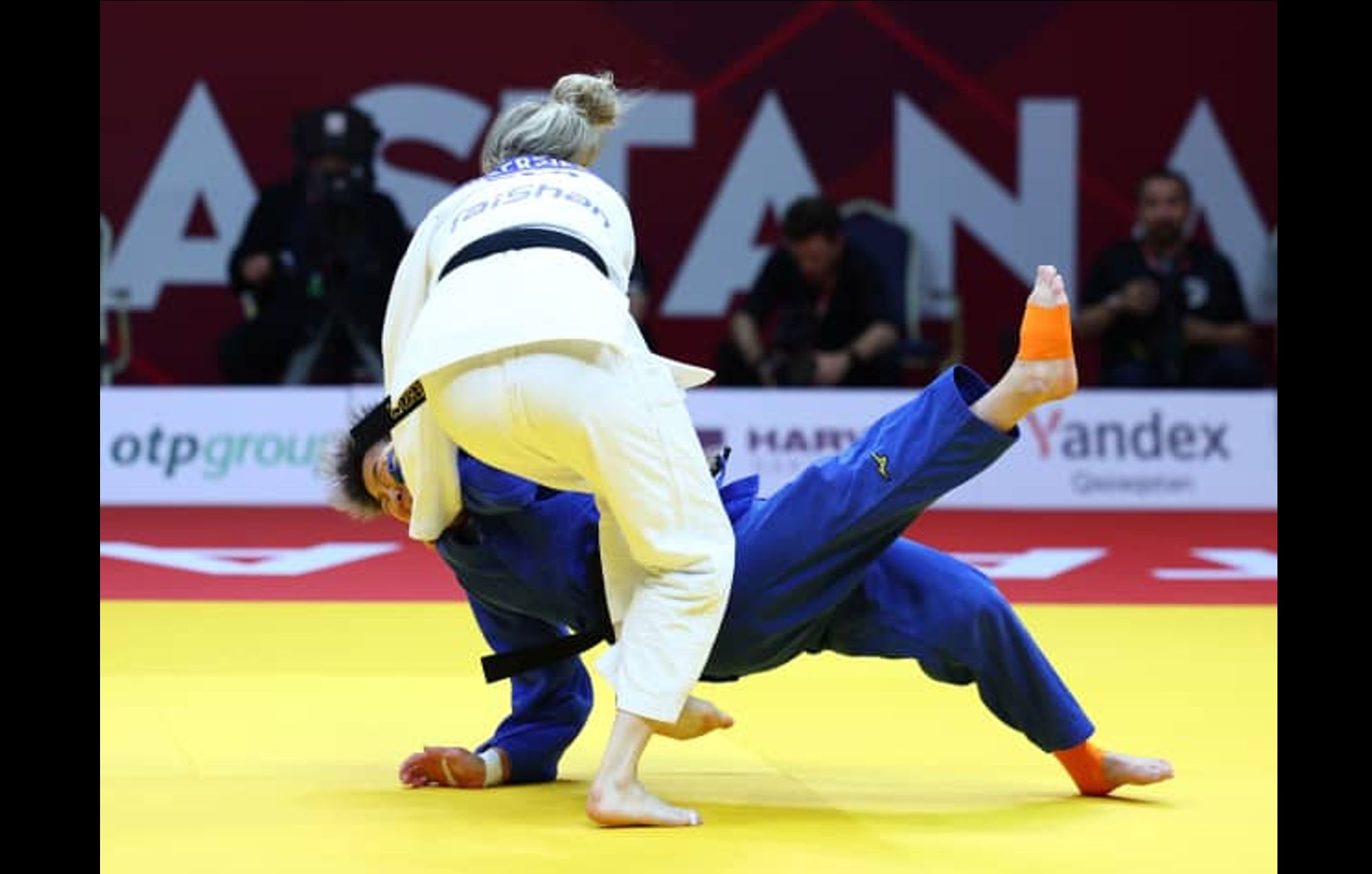
Amber Gersjes of the Netherlands beats Mongolia's Narantsetseg (Photo IJF/Gabriela Sabau, Tamara Kulumbegashvili)
In the lightest of the three women’s categories on the first day of the Qazaqstan Barysy Judo Grand Slam, the -48kg gold medal was set to fly to the Netherlands with recent first-time grand slam medallist Amber Gersjes or to Mongolia with 31-year-old eight-time grand slam medallist Narantsetseg Ganbaatar.
It seemed that the harder the fight became for Gersjes, the better she fought. Totally focussed, strategically prepared and without a single moment of hesitation, the Dutch competitor grew more and more confident as the time ticked away. She scored with a perfectly timed de-ashi-harai, a yuko that gave her a little breathing space.
Ganbaatar was clearly shaken by the score and became less precise, less focussed. Gersjes played a perfect game of attack and defence from that moment on and punched the air as the gong sounded. A week after winning her first grand slam medal, a silver, she upgraded her bounty and won the Qazaqstan Barysy Grand Slam gold.
“I always wanted to get here and finally I found myself. It has been a long way to collect my first grand slam gold and I’m glad because my team always believed in me and helped a lot. I love judo but I had to learn to be patient and this took a while. After last week, I knew this competition would be mine,” said Gersjes.
Precise Pont points at the top of the podium
In the final of the women’s -52kg, Blandine Pont of France and Khorloodoi Bishrelt of the UAE each knew any mistake could be decisive and so there was a reluctance to fight with any risk.
The first shido arrived for each and then a second for Bishrelt but at that point that latter did make a mistake, standing up voluntarily from a ne-waza position in a moment when Pont had the kumi-kata advantage. The French judoka capitalised and threw for a yuko.
Exactly 60 seconds of the fight remained and Point sailed through that time without faltering. It was Blandine Pont’s fifth grand slam gold.
After the final she was open and said, “Since I changed my category last year and came back from a huge knee injury, I have practised harder than ever. I am proud of myself because this year’s success has shown my passion for judo. Although it is only the beginning of a long journey to Los Angeles, I am clear about my goals. My boyfriend, Manuel, told me about the atmosphere in Astana and he was right; the people here love judo and it helps me on the tatami.”
Byambasuren dashes local hopes
Talgat Orynbassar was the man tasked with securing the Kazakhstan national anthem on day one and in front of his country’s president. President Kassym-Jomart Tokayev was present in the arena to enjoy the final block, a committed supporter of sport.
Orynabssar must have felt the pressure but he handled it beautifully, delivering dynamic and entertaining judo from the beginning of the men’s -60kg final.
His opponent, Sukhbat Byambasuren of Mongolia met energy with energy, attacking just as much as Orynabssar and endangering the fairytale finish for the home team. As the final minute approached with no scores on the board, it was in fact Byambasuren who made space to secure a yuko.
In response, Orynbassar, with limited time to structure a game plan, engaged in a full-contact 50/50 situation, but Byambasurenwas ready for anything and hooked on with a ko-soto-gake. He scored ippon and the crowd gasped. The Kazakh flag would be flown in the awarding ceremony but it would be the Mongolian flag which would fly highest of all.
After the final, Byambasuren said, “I really wanted to win in Astana right before Ulaanbaatar, which is one of the most important events for me this year. My confidence comes from the hard work I did in practice and although the Kazakh fans were great, I believed in my judo.”
Nutfulloev claims the top spot
In the -66 kg final, Russian Saigid Kerimov and Uzbekistan’sAbdurakhim Nutfulloev fought it out for the gold. The latter earned a score a little before half time, a yuko. Kerimov tried to apply pressure but Nutfulloev anticipated all attacks and moved well to stay out of danger. He had done enough to claim the gold.