

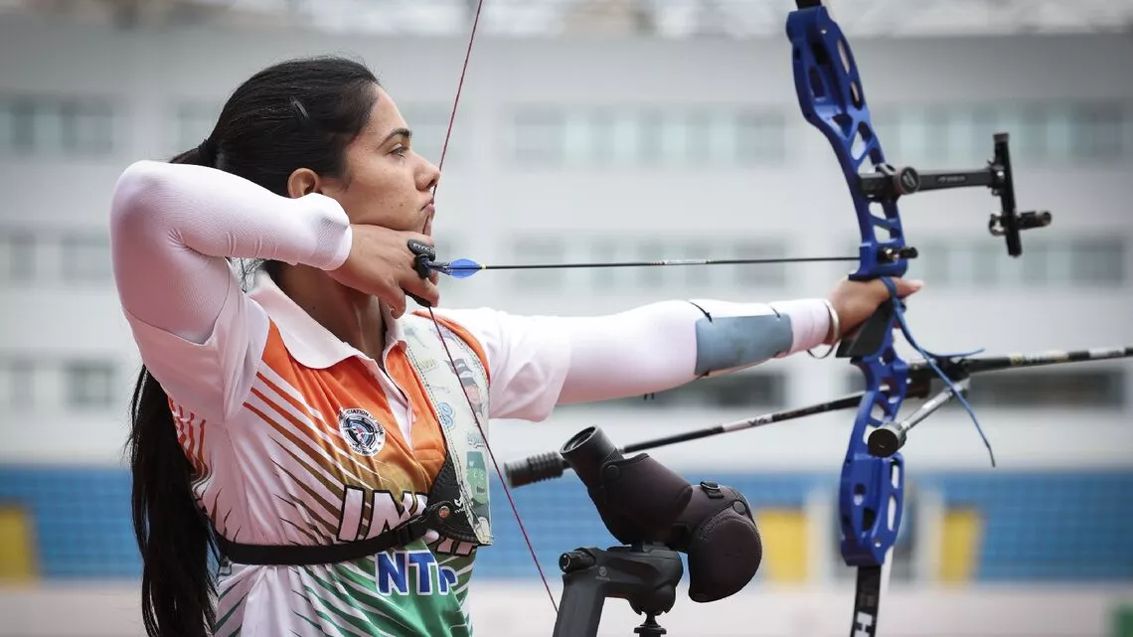
An emotional Simranjeet Kaur proved to be India’s unlikely hero on Friday as she booked a place in the recurve women’s final four at the second stage of the 2026 Hyundai Archery World Cup in Shanghai.
Kaur doubled Fong You Jhu’s 10 count of two in the quarterfinal, posting end scores of 27, 28 and 29 to sweep aside her Chinese Taipei opponent in straight sets at Yuanshen Sports Centre, where the wind proved less influential than earlier in the week.
It will be the first World Cup final stage appearance of her career and the emotion was immediate once the result was confirmed, with Kaur wiping away tears before quickly calling her father.
“I just called my dad after the match and I cried because it actually is a big deal for me and it was long-awaited,” said the 27-year-old. “I feel like this is the best thing which can ever happen to an archer who is preparing for each and every World Cup, the bigger events and all the competitions.”
Kaur explained that throughout the day she repeatedly reminded herself to “detach and shoot” in an effort to remove pressure and expectation from each arrow.
“I think 1000 times today I told myself to detach and shoot,” she said. “Detach from the result, detach from the emotions and everything else – just shoot.”
“From match one and arrow one, I kept telling myself to detach and shoot because when you become too attached to the result or where the arrow is going to land, it becomes very difficult,” she said. “I’ve lost many more times when I was too attached before.”
Mental composure is one of the defining challenges at elite events such as the World Cup circuit.
The technical work is established long before competition begins, but the ability to manage pressure in high-stakes situations is something that can only truly be developed through competition itself.
For Kaur, that challenge is intensified further by the demands of India’s selection system.
The country is known for one of the most competitive national trial structures in world archery, with multiple selection events held each year to maintain depth across every major international squad.
That depth was evident again in Shanghai. Kaur actually finished fourth among India’s recurve women in qualification behind Ankita Bhakat (10th), Kumkum Anil Mohod (11th) and veteran Deepika Kumari (14th).
The Baghdad 2024 Asia Cup silver medallist seeded 15th overall and therefore will not feature in India’s recurve women’s team gold medal match against China, although all four athletes could still leave Shanghai with medals on Sunday.
“They are very long trials in India and we have to shoot very consistently again and again to be in the team,” said Kaur. “The funny thing is, after going back from Shanghai, we have Asian Games trials but I feel like the trials are a bit different from the World Cup here.”
“If you lose one match, it’s finished here, but in the trials you get chances to show consistency and arrow average, so both of them are actually very different things.”
An individual World Cup medal would nevertheless strengthen Kaur’s case ahead of another fiercely contested Asian Games selection process later this season.
Korea’s absence from the recurve men’s final four proved almost as surprising as Kaur’s breakthrough.
Berkim Tumer and Mete Gazoz eliminated Seo Mingi and Kim Woo-jin respectively via shoot-offs, meaning Türkiye could still claim up to five gold medals across compound and recurve competition in Shanghai.
Martin Damsbo returns to final fours after 10-year absence
Martin Damsbo ended a 10-year wait for an individual World Cup medal match by reaching the compound men final four.
The Paris 2013 Archery World Cup Final Champion – who has represented Denmark every year on the international circuit since the opening season in 2006 – was one of three shoot-off winners in the compound men’s quarterfinals, with Sahil Rajesh Jadhav, Nicolas Girard and Sebastian Garcia Flores progressing to Saturday’s stage.
France’s Girard was the only archer to advance without a shoot-off, defeating Bangladesh’s Aishwarzo Rahman 147-145 after five ends.
Damsbo and India’s Kushal Dalal could not be separated at 147 apiece after 15 arrows in an overcast Shanghai, mirroring each other’s scores in three of the five ends. The Dane led after the second end before Dalal levelled the match in the fourth with a perfect 30 against Damsbo’s 29.
“It was a hard day to be old out there today, I think… I feel like it,” joked the 40-year-old, whose 10 in the shoot-off landed closest to the centre spot. “It’s great to be back.”
Damsbo said Denmark’s regular presence in team medal matches meant he never truly felt like he had disappeared from the elite level, but returning to an individual final four still carried special significance.
“The level is just so high,” he said. “Years ago, if you shot well, you won. Now, you also need a little bit of luck to keep going.”
Damsbo admitted he was relieved his X-liner in the shoot-off proved enough to advance.
“I shot a good arrow, and these days that’s not always enough,” he said. “So I was really happy to see it hold up.”
For Damsbo, the result is one built on consistency over nearly two decades competing at the highest level.
He is one of the few athletes still competing from the World Cup circuit’s inaugural season, alongside India’s recurve men’s archer Tarundeep Rai, who also remains active on the international tour.
Nearly two decades after Porec 2006, Damsbo continues competing at the highest level while balancing work, coaching and family life as the sport around him has evolved dramatically.
The 2012 European Championship silver medallist has witnessed compound archery’s growth firsthand, right up to its inclusion at the LA28 Olympic Games, which has also brought increased funding to the Danish compound programme.
“It’s wrong to say that you always go out to do your best and try to win, but I’m also realistic about competing against full-time shooters, young guys, and the funding that’s starting to kick in everywhere,” he said.
“I work anywhere from 40 to 80 hours a week, depending, plus shooting, plus coaching, plus everything,” he added when discussing his workload. “I always just try to be the best that I can be and, like I said, take the luck that it gives me, because I know it’s not an even field.”
“There are people here putting in way more than I’m able to do. I would love to do it, and I used to do it, but just life. So it’s really nice to still be teasing a little bit.”
Damsbo will now test himself further against a younger generation of archers as he faces Garcia Flores in Saturday’s semifinal, with either Jadhav or Girard awaiting in the gold medal match.
A victory would secure his first individual World Cup medal since bronze at Medellin 2016.