


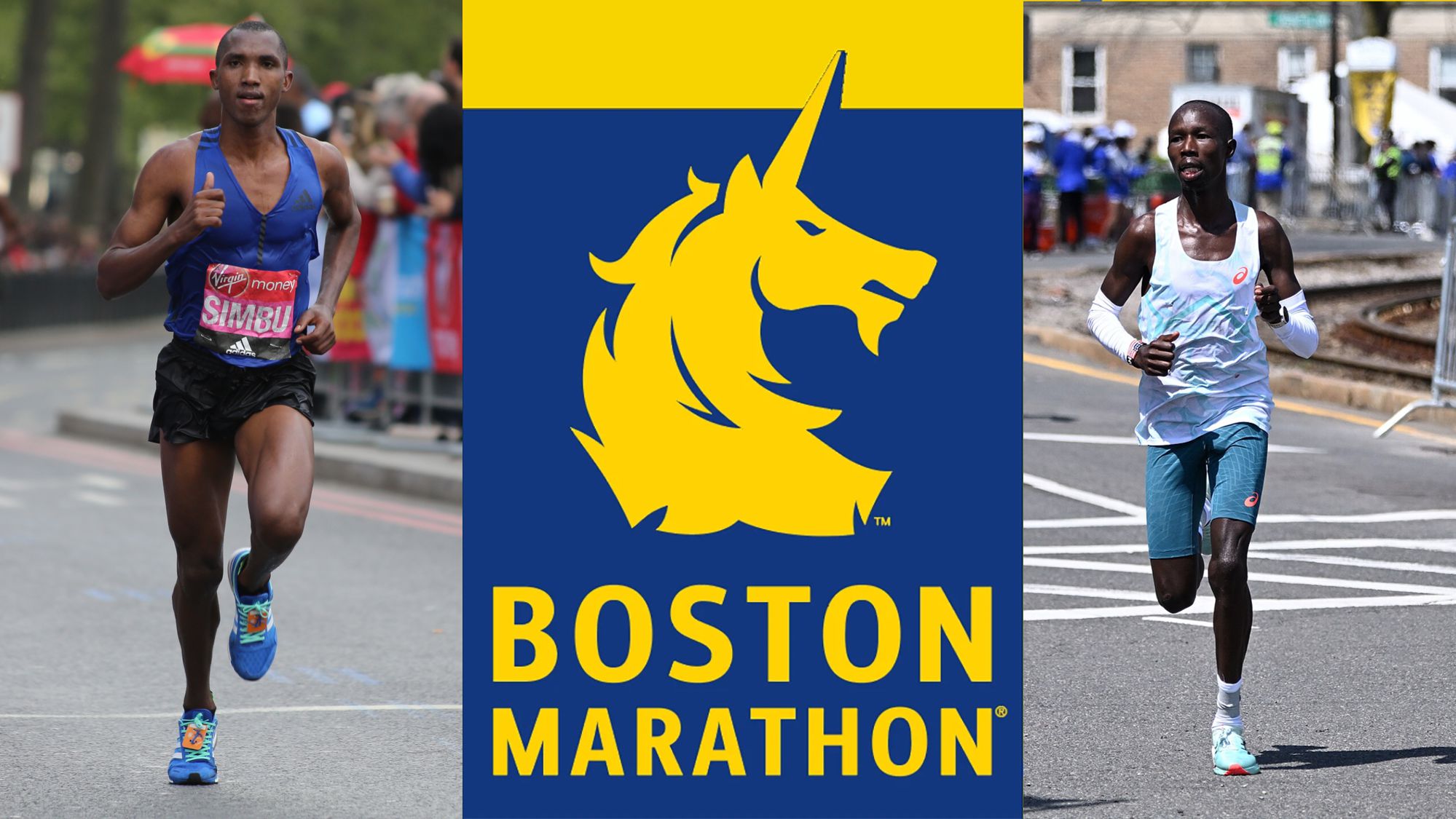
John Koris and Felix Simbu (Photo bu Katie Chan and 4300streetmaster)
The men’s professional field for the 130th Boston Marathon will featuring world and Boston champions, Olympic and Paralympic medalists, national stars and 25 men who have run under 2:07 for the marathon distance.
Leading the impressive line-up are eight of the top ten men’s finishers from 2025, including defending champion John Korir of Kenya, reigning world champion Alphonce Felix Simbu of Tanzania, and third-placer Cybrian Kotut of Kenya.
Korir’s 2:04:45 victory in Boston last year came just six months after he triumphed at the 2024 Chicago Marathon. The Kenyan capped his 2025 season with victory at the Valencia Marathon, clocking a PB of 2:02:24.
Simbu had finished second in Boston last year, just ahead of Kenya’s Cybrian Kotut.
Returning to Boston for the first time since 2023 is Kenya’s Benson Kipruto, winner of the 2021 Boston Marathon, 2022 Bank of America Chicago Marathon, 2024 Tokyo Marathon, and 2025 TCS New York City Marathon. Kipruto is the first person in history to win all three American Abbott World Marathon Major races, plus has an Olympic Marathon medal from the 2024 Paris Games.
Additional international stars include Abdi Nageeye of the Netherlands, the 2021 Olympic silver medalist and 2024 TCS New York City Marathon winner, and Hailemaryam Kiros of Ethiopia, 2025 TCS Sydney Marathon champion.
Ethiopia’s Lemi Berhanu, the 2016 Boston Marathon champion, returns on the tenth anniversary of his 2:12:45 win. Back after top-ten finishes a year ago are Canada’s Rory Linkletter (sixth, 2:07:02) and Lesotho’s Tebello Ramakongoana (eighth, 2:07:19). Alex Masai, third at Chicago in 2025 in 2:04:37, will make his Boston debut.
In addition to previously announced American record holder Conner Mantz, a full cadre of U.S. talent will toe the line in Hopkinton. Two-time Olympic medalist Galen Rupp, 2024 Olympic marathoner Clayton Young, 2:06:53 star Biya Simbassa, and Ryan Ford, the tenth-place finisher from 2025, will compete for the podium on Patriots’ Day.
Zouhair Talbi and CJ Albertson, who have career best finishes of fifth (2023) and seventh (2024), respectively, at Boston, return as well; Talbi recently won the Houston Marathon in 2:05:45.
Olympian Joe Klecker, 2022 NCAA Cross Country Champion Charles Hicks, and Dusseldorf Marathon winner Alex Maier all make their Boston debuts, while Wesley Kiptoo is racing after a 14th-place finish at the World Athletics Cross Country Championships earlier in January.
Meanwhile, Marcel Hug of Switzerland leads the professional wheelchair field, aiming for his ninth Boston win and fourth in a row. As course record holder, Hug will battle perennial contender Daniel Romanchuk, a two-time Boston winner, four-time Paralympic medalist, and reigning B.A.A. 10K champion.
“While the weather may be unpredictable, I can always count on fast competition, a challenging course, and lots of energy each April at the Boston Marathon,” said Romanchuk.
Jetze Plat of the Netherlands and Japan’s Sho Watanabe, third and fourth a year ago, return, as does Britain’s David Weir, third in 2024. American Miguel Vergara, winner of the 2025 Boston Half (49:06) will race.
In the Para Athletics Divisions, familiar faces seek to continue their dominance. Five-time Para Athletics Division champion and course record holder Marko Cheseto Lemtukei (T62/T64; T42/T44 lower limb impairment) aims for win number six.
Tunisian Paralympic gold medalist Wajdi Boukhili timed 2:25:12 a year ago to win the T11/T12 Division and establish a new course record. He’ll face 2023 winner El Amin Chentouf of Morocco, a three-time gold medalist at the Paralympics.
Ethiopia’s Atsbha Gebremeskel looks to extend his winning streak to four in the T45-T47 (upper-limb impairment) classification, though will battle Australian Paralympian Matthew Felton. New Hampshire’s Thomas Cantara aims to win the T20 (intellectual impairment) Division for the third time in as many years.
Finally, Australia’s Deon Kenzie, a two-time Paralympic medalist on the track, is a top contender in the T35-T38 Division (coordination impairment).