



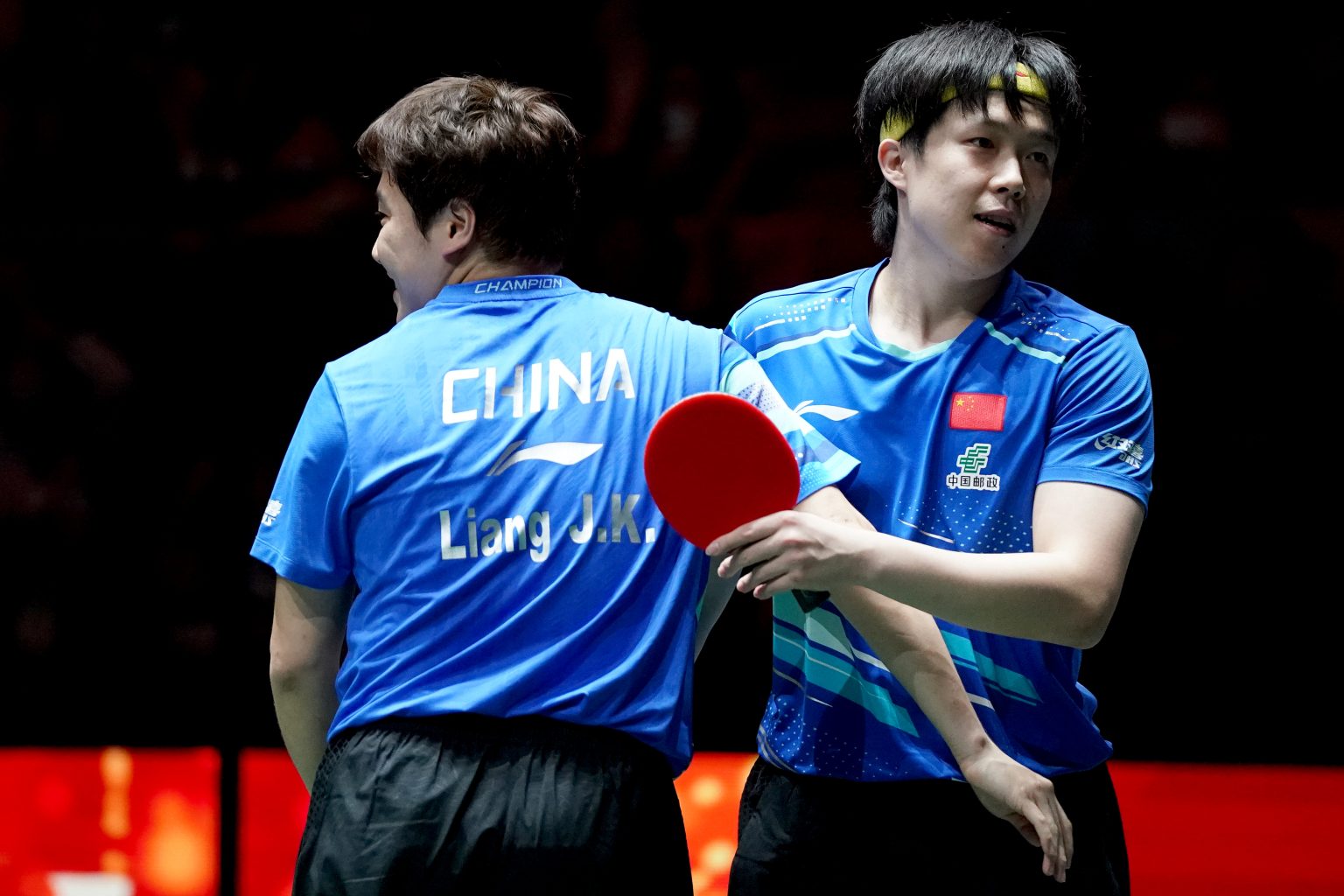
Wang Chuqin and Liang Jingkun (Photo ITTF)
China faced their sternest test yet by Germany in a titanic battle in Stage 2 of the ITTF Mixed Team World Cup 2025 in Chengdu.
With the competition that also serves as a major milestone on the road to LA28, where the Mixed Team event will make its Olympic debut, teams have been stepping up with unexpectedly strong performances.
China were pushed to the very brink by an inspired German team, in what proved to be their toughest fixture of the competition so far before winning 8-4.
The World No. 1 pairing of Kuai Man-Lin Shidong were forced to dig deep against Germany’s Benedikt Duda-Sabine Winter in the mixed doubles. The Chinese pair started well, with Shidong ripping a few classy backhands from close to the table to dominate. But Winter’s ‘anti-spin’ backhand, combined with Duda’s relentless attacks from both flanks, unsettled the Chinese duo from the second game onwards.
The Germans, especially Winter, grew in confidence from the second game onwards, opening up a 7-0 lead. They will rue their missed chance to convert a commanding 7-0 lead in the second game, which slipped away and left them trailing 0-2. Yet they refused to fold, striking back with a 11-9 win in the third game to secure Germany’s first point of the tie.
China responded swiftly and ruthlessly. Sun Yingsha, the World No. 1 in women’s singles, brushed aside Nina Mittelham in straight games. Mittelham showed flashes of brilliance, even snatching an early lead in the opening game and holding her own in several exchanges. But her inconsistency and inability to finish points proved costly against a player of Sun’s ability. With Yingsha’s 3-0 victory, China surged ahead 5-1.
Then came the shock of the morning. Patrick Franziska stunned the home fans, defeating World No. 1 Wang Chuqin.
Franziska appeared calm and composed, executing a clear tactical plan. He targeted Chuqin’s short forehand side and wide forehand angles, mixing in attacks to the midsection to disrupt rhythm. Once he had unsettled Wang, Franziska cleverly switched to pressuring the backhand, exploiting its relative weakness. The confusion he sowed was evident, as Chuqin’s trademark step-around forehand, his deadliest weapon, was neutralized by his inability to anticipate Franziska’s next move.
The first game was edged 12-10 by Franziska, who celebrated with a wink toward the German bench, a gesture of confidence and proof of a plan well executed. Riding that momentum, he won 11-3 in the second, sealing two crucial points for Germany. Chuqin, however, showed his champion’s resilience, regrouping to take the third game.
The men’s doubles that then followed was nothing short of breathtaking, a match that will be remembered as the finest spectacle of the tournament. Wang Chuqin-Liang Jingkun combined forces against Germany’s Benedikt Duda-Dang Qiu, producing a contest of extraordinary quality.
The first two games were shared, setting the stage for a decisive third. At 10-10 in the decider, the rallies reached a level of brilliance rarely seen, with both pairs trading a dazzling display of attacking table tennis. Dang Qiu and Liang Jingkun pulled off outrageous manoeuvres to keep the ball alive, but China won the point to go up 11-10.
The climax came when the ball clipped the edge of Benedikt Duda’s racket and flew out, handing the Chinese pair victory. With their 2-1 triumph in the doubles, China sealed the overall score at 8-4, completing a hard-fought win in a tie that had everything.
Japan continue winning momentum, beat Korea Republic 8-2
Japan firmly secured their place as the team chasing China in the Stage 2 standings, delivering a commanding performance against third-seeded Korea.
Japan had a shaky start, with Shunsuke Togami-Hina Hayata dropping the first game against Oh Junsung-Choi Hyojoo. But they recovered well, conceding only ten points in the next two games as they won 2-1.
The women’s singles clash proved to be the highlight of the evening. Miwa Harimoto survived a mighty scare against Korea’s Lee Eun-hye, edging out a tense 2-1 victory. Lee dominated much of the contest, and in the first game she even held an 11-10 game point. But a costly service error opened the door for Harimoto, who seized the chance and snatched the game 13-11.
The second game followed a similar pattern, with Eun-hye controlling most of the rallies but failing to convert her opportunities. Loose balls went unpunished, and Harimoto capitalized to take it 11-9, securing the match win. Eun-hye, however, showed resilience by keeping her composure and claiming the third game 11-7, salvaging a point for Korea. It would prove to be their second and final point of the night, as Japan closed out the tie with authority. But Eun-hye did well to win the third game 11-7, salvaging a point for Korea.
Sora Matsushima then shifted into beast mode, dismantling An Jaehyun with a ruthless 3-0 victory in the men’s singles. The Japanese teenage prodigy unleashed an attacking rampage: spinning forehand winners that seemed to defy physics, backhand winners struck with casual ease, and forehand slaps delivered with a swagger that bordered on disrespectful. It was less a contest and more an exhibition of nonchalant attacking table tennis, leaving the crowd in awe of his talent.
With the tie all but secured, Hiroto Shinozuka-Shunsuke Togami stepped in to finish the job. Needing just one game in the men’s doubles to seal the overall win, they beat Oh Junsung-An Jaehyun 11-6. The result capped off Japan’s commanding triumph, a performance that underlined their depth and firepower as they closed out Day 6 in style.
Croatia stun Sweden, win 8-1 on Table 1
The day also saw Croatia return to their giant-killing ways, producing a stunning 8-1 victory over Sweden.
Croatia’s Ivor Ban-Hana Arapovic continued their dream run in this tournament, giving their team the perfect start in the mixed Doubles. Up against the in-form pairing of Kristian Karlsson-Christina Kallberg, the Croatian duo showed a different side to their game. While Ban has often imposed himself with power in previous matches, this time both Ban and Arapovic relied on touch and feel, refusing to let the Swedes dictate the pace. Their variety proved decisive, and Croatia struck the opening blow.
Lea Rakovac then delivered another shock, defeating Swedish chopper Linda Bergstrom in straight sets. Rakovac initially struggled against Bergstrom’s variations, but the Croatian coaching team provided quick solutions. Adjusting her approach, Rakovac found the right balance between calculated attacks and patient play.
Following the template set earlier in the tournament by Zhu Chengzhu of Hong Kong, she deliberately played balls of lower quality:reduced spin and speed, to draw errors from Bergstrom, accelerating only at the right moments. Fortune also favoured her, with a few points coming off net and edge clips. But Rakovac’s overall was superb, completing the 3-0 win.
With Sweden trailing 1-5, they looked to talisman Anton Kallberg to kickstart the comeback. But Croatia’s Tomislav Pucar produced a commanding performance to extinguish those hopes.
Known for his dominance from the backhand side, Pucar surprised Kallberg by mixing in his forehand more effectively, even employing the step-around forehand at key moments to inflict maximum damage. His serving was equally intelligent, especially under pressure, as he opted for long, heavy backspin serves that forced mistakes from Kallberg. From start to finish, Pucar was in control, sealing a 3-0 win and completing Croatia’s emphatic 8-1 triumph.
10th seeded Hong Kong keep Stage 3 hopes alive, score upset win over 6th seeded France.
Hong Kong snatched an 8-7 win, handing France yet another agonizing loss.
Hong Kong began the fixture brightly, with Baldwin Chan-Zhu Chengzhu delivering the perfect start in the mixed doubles. Facing Felix Lebrun-Prithika Pavade, the Hong Kong pair edged a tense opening game 17-15, only to be pegged back 9-11 in the second.
But Chengzhu, the more experienced of the two, rose to the occasion. She steadied her younger partner, took control of the exchanges, and guided them to an 11-7 win in the decider, securing a 2-1 victory.
France struck back immediately with a statement win. Charlotte Lutz stunned Hong Kong legend Doo Hoi Kem in the women’s singles. Lutz, whose improved forehand has already drawn attention in this competition, unleashed it to devastating effect, combining it with a consistent backhand close to the table.
She shocked Hoi Kem by taking the first game 11-9, then overwhelmed her 11-5 in the second. Hoi Kem salvaged the third, but it was little more than consolation, as France celebrated a massive 2-1 win to level the tie.
Momentum stayed with France in the men’s singles. Simon Gauzy, chosen ahead of the Lebrun brothers, justified the decision with a superb performance against Wong Chun Ting. After splitting the first two games 11-9 apiece, Gauzy elevated his play in the decider. He added extra kick and topspin, particularly from the backhand side, sending balls that bounced higher and forced awkward edges off Chun Ting’s forehand. Unable to adjust, Chun Ting faltered, and Gauzy dominated 11-5 to seal the win. Remarkably, Gauzy had trailed 1-5 in their head-to-head before this fixture, making the victory all the more significant.
It was advantage France as they led 5-4 going into the men’s doubles. Alexis Lebrun and Simon Gauzy faced the World No. 1 pairing of Baldwin Chan-Wong Chun Ting. The French duo made a dream start, edging the first game 14-12 with clever use of heavy sidespin pushes on the receive, unsettling Chan-Chun Ting.
Chun Ting, still reeling from his singles defeat, struggled to find rhythm. It was Chan, 14 years his junior, urging him on and keeping him composed. France pressed again in the second, racing to a 10-8 lead, but Chan-Chun Ting came back to win it 12-10. That turnaround proved pivotal. Instead of France moving 7-4 ahead going into the third, the score was 6-6 at the end of the fixture as Chan-Chun Ting won the third game.
The final act fell to Zhu Chengzhu-Doo Hoi Kem in the women’s doubles. They started strongly, taking the first game and leading in the second. But nerves crept in as France’s Jia Nan Yuan-Prithika Pavade fought back to steal the game 11-9. With the tie hanging in the balance, Chengzhu-Hoi Kem regrouped magnificently. They stormed through the decider 11-2, sealing a 2-1 win and clinching the overall score at 8-7.