



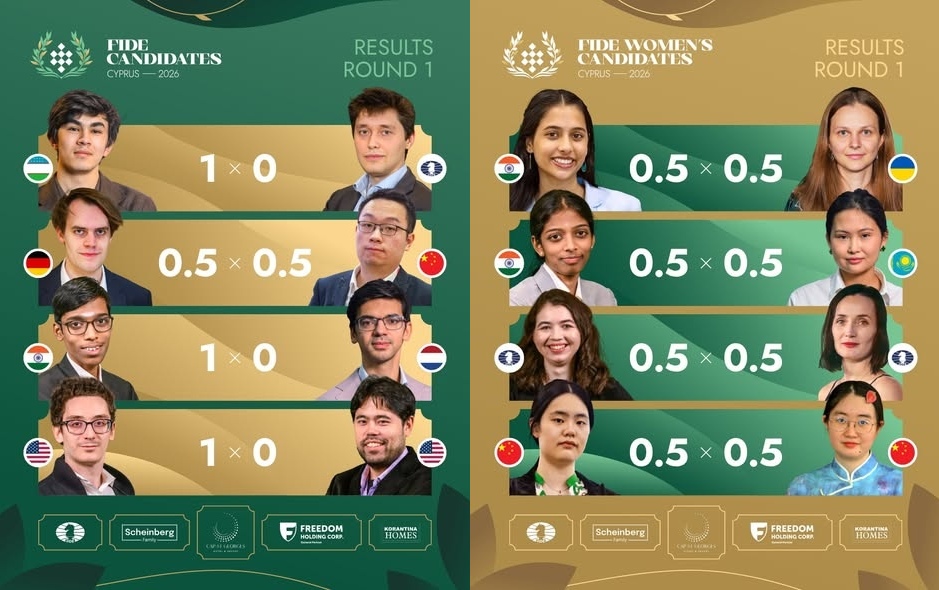
Three of the pre-event favourites – Fabiano Caruana, Rameshbabu Praggnanandhaa and Javokhir Sindarov – scored their first wins to take the early lead at the FIDE Candidates in Cyprus. With three decisive results in four games, the tournament is already shaping up to be a memorable event.
In his game against Fabiano Caruana, Hikaru Nakamura was caught off guard in the latter stages of the opening and soon came under heavy pressure, both on the board and on the clock. Although Hikaru defended resourcefully and created some drawing chances along the way, he ultimately had to concede. The game concluded on a sporting note, with both players analysing the encounter together.
Caruana admitted he felt tired and somewhat embarrassed, but ultimately pleased with the result. For fans looking to better understand opposite-coloured bishop positions – with and without major pieces – the game was a must-see encounter.
Exceptionally well prepared for his game, Praggnanandhaa opted for the Grand Prix Attack – a rare choice at this level. Caught by surprise, Anish Giri spent a significant amount of time navigating the opening, while the Indian prodigy played his moves at a rapid pace.
“I think this line is playable and takes my opponent out of theory,” Praggnanandhaa explained after the game.
Giri admitted he had anticipated a deviation, though not this particular one. “Although it was OK until I blundered, my position was gradually becoming unpleasant,” he said. The Indian grandmaster went on to convert his advantage with excellent technique in the rook ending.
Andrey Esipenko handled the opening well against Sindarov with the black pieces, but he began to go astray as time trouble approached. “I think my mistake was 27…Bxf3, and afterwards I didn’t have enough time and couldn’t figure out what to do,” he said after the game, an assessment immediately confirmed by his opponent.
“Now I have more space to manoeuvre my pieces, and his king is not safe,” explained Sindarov. Reflecting on the decisive phase, the Uzbek grandmaster added: “After I got my chances, I think I played well, and I also believe I handled the time trouble better.”
The game, between Matthias Bluebaum and Wei Yi, ended in a solid draw. “I was surprised by 10.Bb5 and forgot the theory after that,” admitted Wei Yi. “Black is always extremely solid, and of course if I manage to get a knight to d4 I can try for something, but he did quite well to prevent that,” added Bluebaum after the game.
In the Women’s FIDE Candidates Tournament, all four games ended in draws, underlining the closely matched level of the contenders. Divya Deshmukh introduced a relatively new idea in the Scotch Opening (12.Bh3), a line previously seen in games by Nodirbek Abdusattorov, catching her opponent off guard.
Anna Muzychuk, who joined the event in Cyprus following the last-minute withdrawal of Humpy Koneru, spent considerable time in the opening searching for a solution, and eventually managed to simplify the position to a draw.
In the all-Chinese encounter, Zhu Jiner unveiled a spectacular piece of home preparation, beginning with the pawn sacrifice 15.f4!, putting Tan Zhongyi under significant pressure both on the board and on the clock. However, the former World Champion proved resilient, defending with precision and ultimately securing a draw.
Meanwhile, R Vaishali introduced a new idea in the Sicilian Kalashnikov (5.Ne2 instead of the highly theoretical 5.Nb5), but was unable to generate a tangible advantage from the opening. “I thought I had some chances during the game, as I had much more time, but the position was difficult to evaluate,” said Bibisara Assaubayeva. Vaishali once again demonstrated her defensive skills, holding the position to a draw.
In the fourth game, facing Katerina Lagno, Aleksandra Goryachkina missed a major opportunity to score the first win of the tournament.
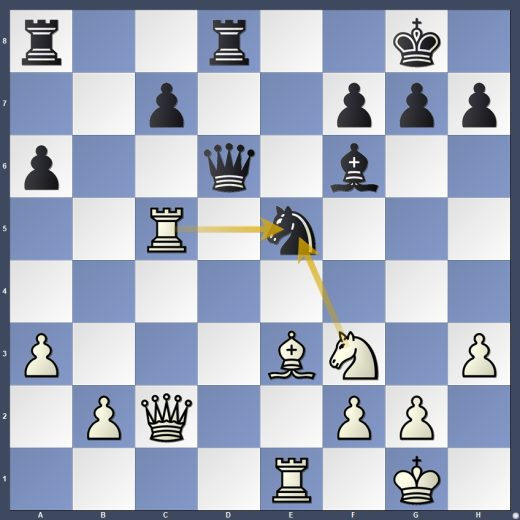
Instead of 24.Nxe5?, the winning continuation was 24.Rxe5!, and after 24…Bxe5 25.Bc5!, White would have recovered the piece with two minor pieces for a rook, securing an overwhelming advantage.