



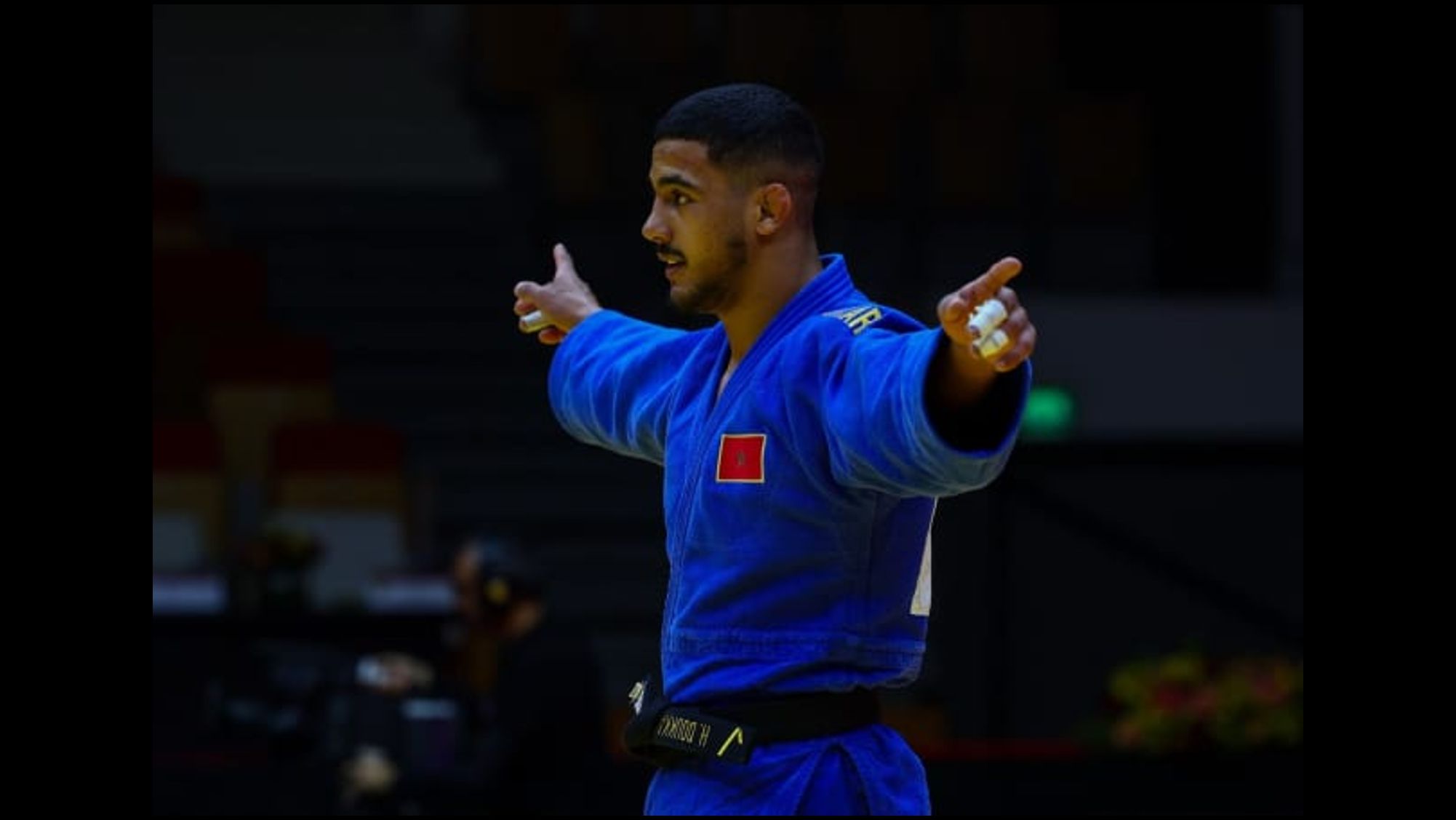
Hassan Doukkali (Phoito IJF/Gabriela Sabau, Tamara Kulumbegashvili)
An historic first ever gold medal for Morocco was at stake in the tense men’s -73kg final at the Abu Dhabi Judo Grand Slam. Hassan Doukkali did not have an easy ride to reach the final but he held his nerve throughout the day and reached the final in great shape.
In the final, Masudi Ahmadzod was also searching for his own first grade slam medal and he attempted to impose his grip from the beginning of the four minutes. Doukkali was ready for everything and during a big attack from Ahmadzod, he turned the tables and countered for a yuko.
With two minutes still on the clock, his lead was not guaranteed to be the final result. Ahamdzhoid threw everything he had at Doukkali but despite a very close escape from the potential to be held down, the Moroccan judoka managed to secure the win, an important one, the first ever gold for Morocco at grand slam level.
Doukkali explained, “I’m very happy and proud to win this gold medal at the Abu Dhabi Grand Slam. It means a lot of things for me. I’m proud for myself; after a lot of chances, finally I’m a gold medallist. I’m happy because I fight for Morocco as a country too, as well as a sport federation, and that makes me feel a lot of things. It’s a big step for me.”
Pelivan takes gold in an unpredictable category
The first score of this all-action men’s -81kg final came from Petru Pelivan who chased Ihanamaki and forced the right position for a small ashi-waza to score a yuko. Front that point on he made it difficult for the Finnish judoka to get close to him.
Pelivan defended vehemently, earning himself two penalties but with the clock on his side he was able to hold his lead and cross the line in first place. Both judoka gave great performances in Abu Dhabi and can be proud of a good day’s work.
“I feel fulfilled,” said Pelivan, “Because this is my first gold medal at an IJF tournament. I don’t even know what was different today. Perhaps how I prepared, how I motivated myself for these fights was a bit different compared to other competitions. After the final though, I won’t celebrate too much because this is not the real goal that I desire.”
Szymanska secures gold
Angelika Szymanska was determined to lead the women’s -63kg final from the first ‘Hajime,’ attacking with tomoe-nage almost immediately. Anna Kriza had done her homework where the gripping was concerned but that wasn’t enough to stop Szymanska, a seasoned competitor at world level.
The Polish athlete stayed ahead and at the halfway point managed to hook in with an o-uchi-gari to score waza-ari. Kriza pressed very well but Szymanska was ready for it and scored a yuko to extend her lead. As the last seconds approached, a lapse in comcertation cost Szymanska a clean sheet and she gave Kriza a yuko but the gold medal was hers. This is Angelika Szymanska’s third grand slam gold medal.
After the final Szymanska said, “Today I expected a good result because I was disappointed after the worlds. I told my coach we were going to Abu Dhabi to win and I did it. I want points early in the qualification period so I can have a relaxing period to prepare for bigger challenges. I’m really impressed by my opponent’s amazing previous months. She’s a strong new opponent on my way to the medals and I wish her the best. I was second at the world championships here two years ago, so I think it’s a lucky place for me.”
Tais Pina’s new crown
The women’s -70 kg final went back and forth between Cardoso and Pina, one dominating and then the other. Not much separated them and as the last half a minute approached there were just a couple of penalties on the scoreboard.
Tais Pina made a clear choice to change tack and with golden score in their sights, created an advantage in the transition phase of an exchange. She secured the osaekomi and held on for the full 20 seconds to take the win and the gold just four seconds before the end of the contest time.
The new Abu Dhabi Grand Slam champion said, “I’ve been looking for that triumph since Kazakhstan in 2024, so it’s time to win a gold medal. Finally I have the gold medal around my neck again. It’s really important because these past few years have been really hard. It’s nice to get points in the Olympic qualification period.”