
Masatora Kawano (Photo JAAF)
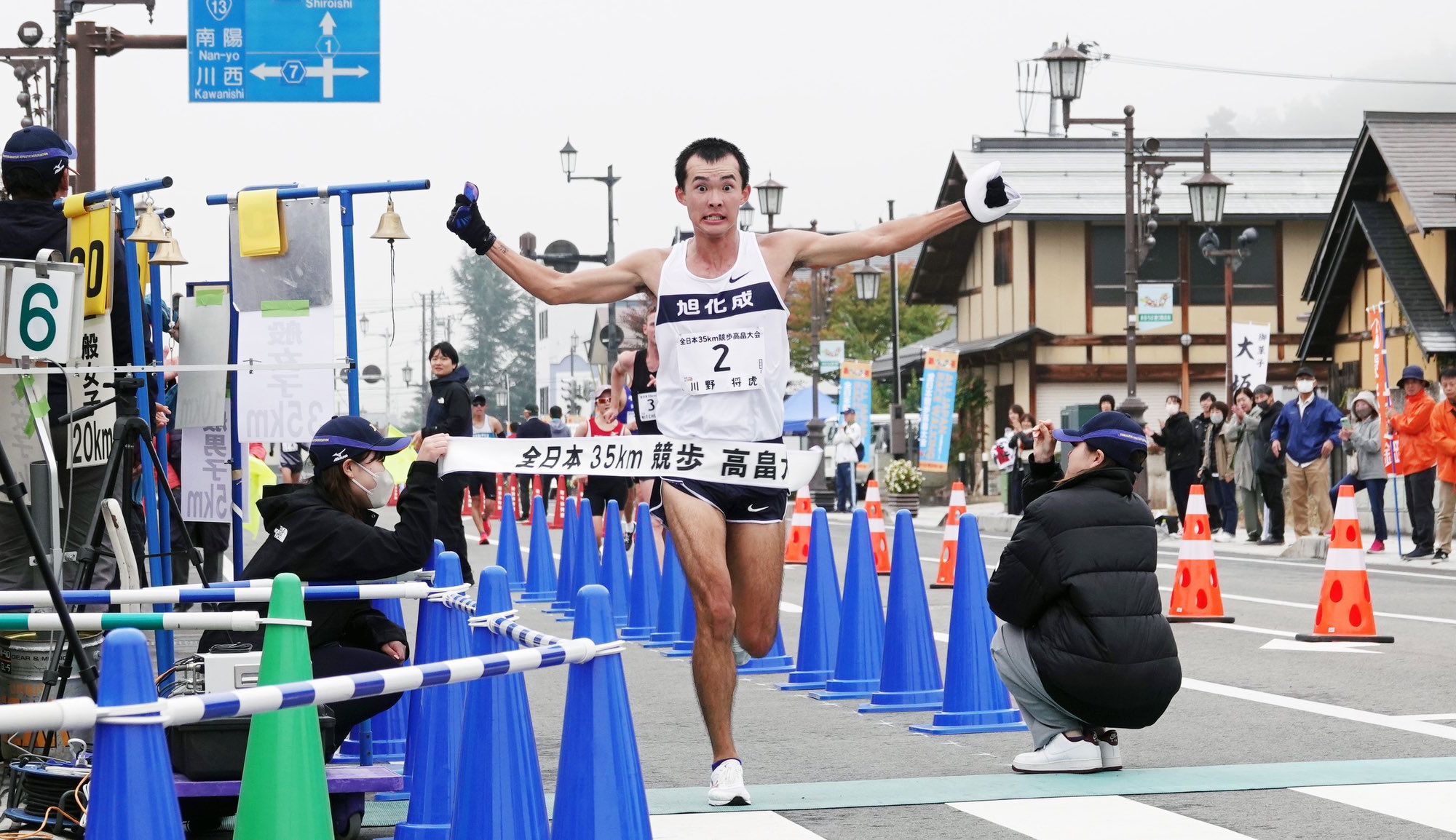
Australia’s Rebecca Henderson and Japan’s Masatora Kawano set respective world marathon race walk records of 3:14:52 and 2:55:14 at the All Japan Race Walking meeting, a World Athletics Race Walking Tour Bronze event, in Takahata on Sunday.
The weather was dismal but the racing was red hot as former 35km world record-holder Kawano put the hammer down to move away from a group of five at 36km and become the inaugural men’s world record-holder for the marathon distance. His time also beat Hayato Katsuki’s 2:55:28 set on the same course in 2025.
Commonwealth Games bronze medallist Henderson improved on the 3:15:11 women’s world record set by Sofia Fiorini at the European Championships in Birmingham in August.
The results were all the more remarkable in races held in the pouring rain and on a course with a slight rise and fall of around a metre each lap. Not crucial on its own but telling when you have to go up and down 42 times.
Six athletes held sway in the men’s race before two-time world medallist Kawano went into overdrive at the 36-kilometre mark. The only one able to give chase was Kazuya Iwai, and even then he was 15 metres back with the other four unable to respond.
Iwai’s brave effort was eventually rewarded with a fine 2:55:55 for second place, while Kazuki Takahashi was third – the same position he claimed at the Asian Games in March, only then it was in 3:02:45. This time he clocked 2:56:45.
Katsuki finished fourth in 2:56:59 and Satoshi Maruo fifth in 2:57:07, all of them way under the standard required for World Athletics Championships Beijing 27 eligibility.
The half marathon and marathon became official race walk distances from 1 January 2026, with 2:56:30 set as the performance standard required for the inaugural men’s world marathon race walk record. Kawano achieved it on his marathon debut, back in the same town where he set his former world 35km race walk record in 2024.
In contrast, Henderson – also making her marathon debut – race walked solo from start to finish with a steady but powerful rhythm that saw her pass many men in the huge field once the early charge settled down.
At 20.195km, the 25-year-old recorded 1:33:39; a lead that had grown to more than six minutes over Ayane Yanai. That gap increased again to 8:04 by 25km and a huge 14 minutes by the end.
Even so, the 3:29:10 by Yanai in second place was still a Japanese record. Veteran Masumi Fuchise was third in 3:38:42.
A dozen athletes shot away at the start of the men’s half marathon but by 10.0975km Tomohiro Noda led in 39:31, with Kento Yoshikawa, Yuta Koga and Taisei Yoshizako breathing down his neck.
That breath became a whisper when Noda accelerated all the way to 15.0975km. He made that point in 58:31, a lead of 18 seconds over Yoshikawa who in turn had a 12-second gap to Yushi Nakajima.
However, that turn of speed was to cost the leader dearly as Noda was dramatically herded into the penalty zone in sight of the finish line.
It left the door open for Yoshizako to record the best win of his career, one that went hand in hand with a personal best of 1:22:04. He needed help to stand after crossing the finish line but recovered just in time to see Yoshikawa follow him home seconds later in 1:22:11.
Elizabeth McMillen put her head down to tackle first the rain and then the opposition in the women’s half marathon.
The Australian Commonwealth Games silver medallist was 1:30 up on Japanese champion Nanako Fuji by 10km and went on to win in 1:31:31 – the fifth-fastest time for this new event.
Her personal best had been 1:38:29 set at the World Athletics Race Walking Team Championships earlier in the year. This new milestone – just short of seven minutes – equates to around a 1.5km improvement in just seven months.
McMillen went through 20km in 1:26:50 on the way. She might have grimaced as she splashed her way through, but she saved a deserved smile for the finish.
Fuji prevailed in 1:35:15 to take the domestic title.