


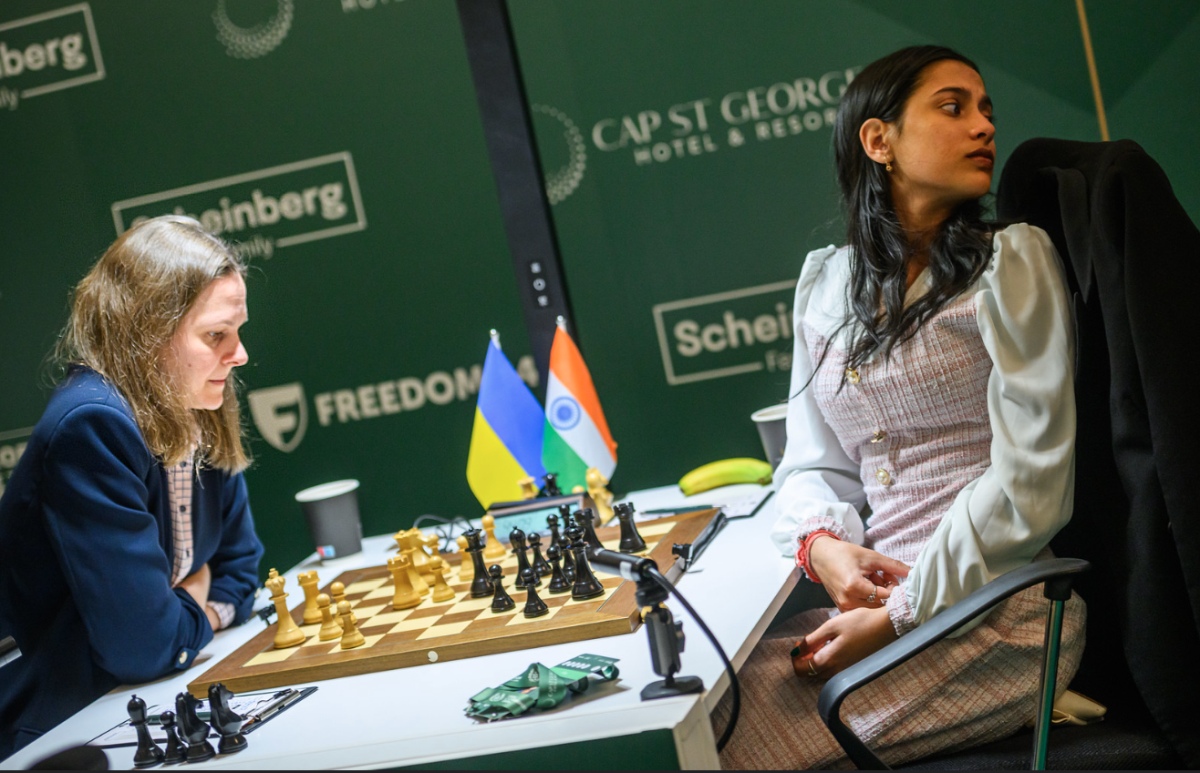
Anna Muzychuk beaten by Divya Deshmukh (Photo FIDE/Michal Walusza, Yoav Nis (Eugene Nisenbaum))
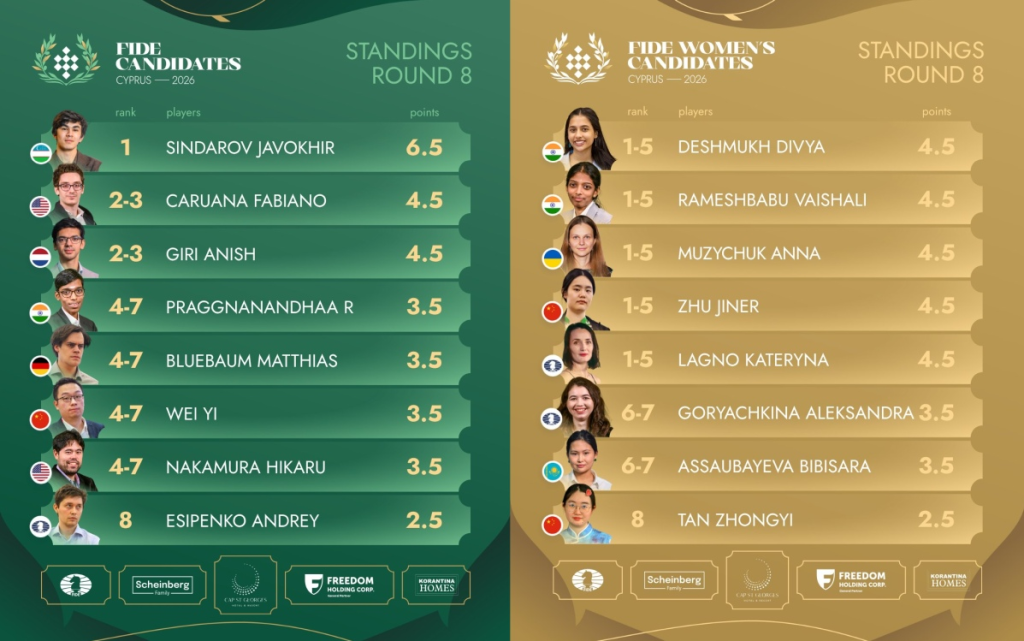
Reinvigorated after the second rest day, the sixteen contenders returned to the playing hall for the first of seven rounds in the second half of the Candidates tournament in Cyprus. Playing with Black, FIDE Candidates tournament leader Javokhir Sindarov held Andrey Episenko to a draw to strengthen his lead.
Combined with Fabiano Caruana’s loss against Hikaru Nakamura, the result leaves Sindarov two full points clear of the field. Meanwhile, Anish Giri narrowed the gap by defeating Praggnanandhaa R in a finely played technical game.
In the FIDE Women’s Candidates, Anna Muzychuk lost to Divya Deshmukh, leaving five players tied for the lead and the tournament wide open. Three decisive outcomes in Round 8 highlight the remarkable balance and competitiveness of the women’s field.
As usual, Sindarov blitzed out his moves in a main-line Catalan, building up more than a 30-minute advantage on the clock. “I prepared very well. I expected a Catalan and a long game, and after the opening I reached a position from my preparation,” he explained afterward. On move 20, he made a well-judged pawn sacrifice to seize complete control of the light squares. “I understood that if I didn’t sacrifice a pawn, I would be slightly worse.”
Episenko spent nearly half an hour searching for a better continuation but ultimately found nothing more than a threefold repetition – an evaluation even the engines confirm.
Meanwhile, on the other board, the tournament pursuers were in need of points. Nakamura has traditionally enjoyed a strong record against Caruana, but he has not been performing at his usual level in Cyprus. Still, in his recaps he continues to stress a “game-by-game” approach, ready to seize any opportunity that arises.
Caruana soon found himself significantly behind on the clock, down nearly an hour.
Nonetheless, Fabiano’s solid play kept him well in the game, as he gradually simplified into a double-rook endgame, positions that are notoriously tricky to handle.
Position of the day
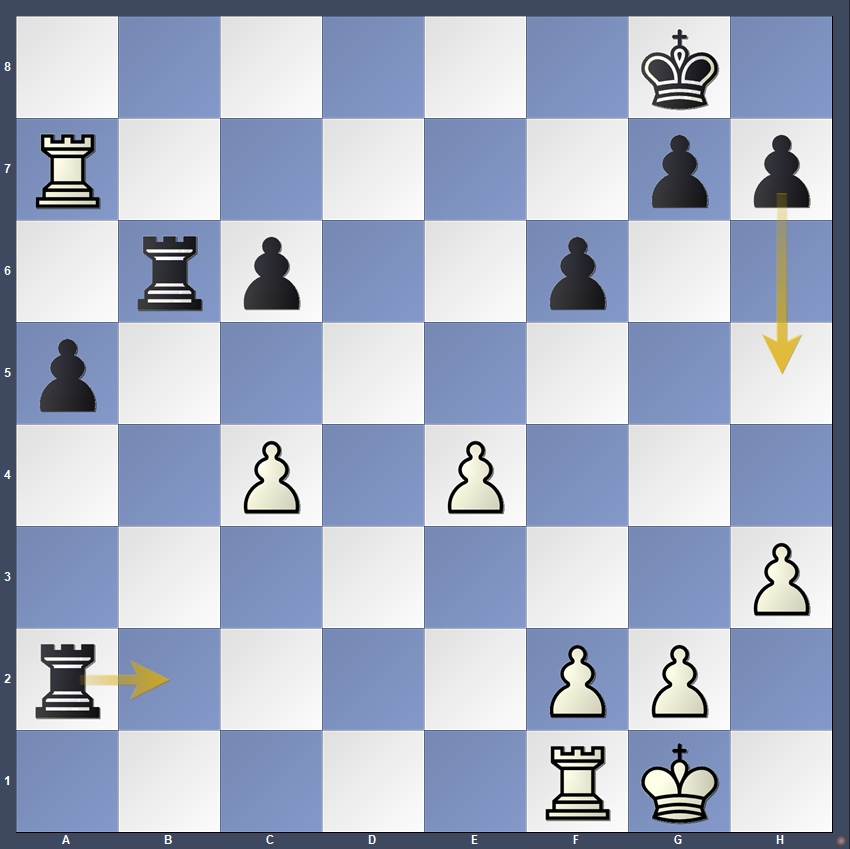
With around fourteen minutes on his clock to make twelve moves, Fabiano Caruana played 28…h5?
Although he was already slightly worse in the endgame, Caruana still had solid drawing chances with 28…Ra-b2!, conceding the a5-pawn but activating his rook along the second rank and heading for a defensible rook ending a pawn down.
The problem with 28…h5 is that after 29.Rd1! Rb-b2 30.Rd8+ Kh7 31.Rd7! Rxf2 32.Rxg7+, White’s rooks penetrate decisively to the seventh rank. In such positions, their activity becomes overwhelming. Even though Nakamura had to work until move 67 to convert the advantage, the outcome was no longer seriously in doubt.
Praggnanandhaa opted for one of the sharp and unbalanced lines in the Queen’s Gambit Accepted that he enjoys so much, but once again Giri’s opening preparation proved excellent, with the Dutchman only beginning to think seriously around move thirteen.
Capitalizing on a couple of inaccuracies, Giri steered the game into a position featuring a strong knight against a weak bishop, along with a slightly superior pawn structure.
From there, the grind began: the Dutch grandmaster methodically created a passed pawn, which ultimately decided the game in his favor.
Wei Yi once again returned to his favorite Vienna Game–Bishop’s Opening, a surprising choice after the rest day, when his opponent would have had ample time to prepare. He offered an early pawn sacrifice, which Matthias Bluebaum declined in favor of a more solid approach with Black: a sensible strategy against such an aggressive opponent.
Still, Wei Yi is always looking to complicate matters, and he soon found a way to sacrifice an entire rook to expose Black’s castled king. Although the engines suggested nothing more than a perpetual check, Wei Yi spent over half an hour searching for winning chances before ultimately having to settle for a draw.
In the FIDE Women’s Candidates, the day’s results have dramatically reshaped the standings, with five players now tied for first place and six rounds remaining. The most important encounter featured Muzychuk against Divya.
Around move twenty, Muzychuk was already enjoying a clear spatial advantage, with no weaknesses and promising attacking prospects on the kingside.
Muzychuk gradually pressed her advantage and at one point reached a completely winning position, but she faltered in time trouble. The position eventually simplified to a draw, but in an attempt to play for more, she overpressed and ultimately had to concede defeat. A major setback for the Ukrainian grandmaster, who now shares the lead with four others after previously holding a full-point advantage.
Divya said she should have won one of her earlier games as well, describing both that one and this encounter as topsy-turvy. She added that, in the end, things tend to balance out.
In her game against Aleksandra Goryachkina, Kateryna Lagno introduced a relatively new idea featuring a positional pawn sacrifice. The concept proved effective, as Goryachkina soon fell behind on the clock and, although she may have suspected the pawn capture was not the most accurate, she was unable to find a satisfactory alternative and quickly drifted into a clearly lost position.
“I think Goryachkina probably didn’t know the opening well and may have played 15…f5 to get out of my preparation, as I was blitzing my moves,” Lagno noted in her post-game interview.
In another key encounter, Zhu Jiner, playing Black in a classical Nimzo-Indian Defence, faced the Capablanca Variation with 4.Qc2 from Tan Zhongyi. Both players blitzed through the opening phase, but once theory ended Zhu Jiner began to think deeply, eventually formulating a strong plan that left her with a comfortable position against an isolated d-pawn.
She steadily increased her advantage, achieving an impressive 95% accuracy performance, while keeping her chances alive in the race to win the event and qualify for the World Championship match.
In the final game of the round, R Vaishali repeated the same line she had used successfully in round six against Bibisara Assaubayeva, reaching a comfortable and playable position that came as a surprise in the commentators’ booth, given Assaubayeva’s opening choice.
Nevertheless, Assaubayeva managed to keep things under control. Although Vaishali pressed her small edge into the endgame, the game ultimately fizzled out into a draw.