



Haruka Kaju defeats Kirari Yamaguchi ( Photo by Gabriela Sabau, Emanuele Di Feliciantonio/IJF) Share
Haruka Kaju was the favourite from the outset and she lived up to all expectations at the Tokyo Grand Slam judo championships.
Up against teammate Kirari Yamaguchi, she attacked and scored with a low ko-uchi-gake early on. She continued on the ground, tying Yamaguchi in knots. The ippon was called to signify the extension of Haruka Kaju’s unbeaten run. She now adds the 2025 Tokyo Grand Slam gold to the Paris Grand Slam she won earlier last year.
Her personal medal tally includes this years World Championships, Asian Championships and Guadalajara Grand Prix.
In another all-Japanese final, Akari Omori and Momo Tamaoki each wanted the women’s -57kg title as much as anyone could. Winning gold at home is a prestigious achievement.
The final was fast paced but also carefully considered. Neither wished to give the other an opening and both wanted to show their best judo; it was an inevitably close contest. In the end, Omori took the victory and the gold, attacking more cleanly than Tamaoki, penalties deciding it.
It was another Japanese showdown in the women’s -48kg final between Sachiyo Yoshino and Wakana Koga.
Yoshino took the initiative and surprised Koga with a ko-uchi-gari for a yuko; she had the lead. It was short-lived though as Koga turned Yoshino and held her on her back for 20 long seconds. It was gold for Koga and silver for Yoshino.
The women’s -52kg gold medal was predicted to go to Uta Abe from before the morning’s first “hajime.” No matter how many titles a judoka has though, nothing is ever guaranteed and Uta Abe knows that better than anyone. She worked clinically in the final to ensure teammate Nanako Tsubone would have no opportunity to express her best judo.
At the halfway point there was no clear separation, Tsubone competing confidently despite the mountain she would have to climb to win the gold. Abe chose to put light between them at that point and attacked with a turbo-speed o-soto-gari which earned her a yuko and some breathing space. Despite pressure from her opponent rising, Abe held her nerve and her score and was buoyant to win the gold medal at home.
The men’s -90kg final saw Olympic silver medallist and current world champion Sanshiro Murao of Japan face 2024 world champion and fellow Japanese Goki Tajima, an immense match-up that had the crowd on their feet.
Murao had not won in the earlier rounds all by big scores but he looked stronger and stronger as the day progressed and let’s be clear that his red backpatch is sewn on his judogi for a reason.
Murao, even though challenged by another top level judoka, stayed calm and dominant. He threw with uchi-mata and the referee initially gave it ippon but the review system downgraded it to waza-ari. So, Murao gripped up and simply did it again; what an incredible display of his ability.
Georgian Ilia Sulamanidze took on home athlete Dota Arai for the men’s -100kg final, a battle of Asian and European styles, a left vs right gripping battle and two great athletes giving everything to exhibit their best judo.
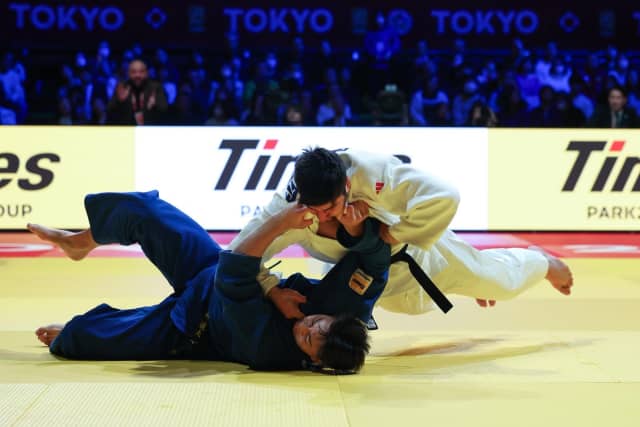
Arai was first to up the tempo, launching several massive o-uchi-gari and uchi-mata attacks, dangerous enough to force Sulamanidze into survival mode, a position he did not wish to b win. A great judoka, a description that fits the Georgian perfectly, never lets these moments affect them for long and he therefore recovered fast and in the next exchange he reasserted himself.
He came for an o-soto-gari, which Arai avoided, but it was too late, Sulamanidze had already executed his plan, linking an immediate o-soto-otoshi to the previous movement. Arai spun right through his back; it was a clean and skilful ippon.
This was the first of two non-Japanese gold medal of the day with Arai clinching it for Georgia.
The men’s +100 kg final saw host nation judoka Hyoga Ota face Valerii Endovitskii of Russian. Each had dominated their side of the draw in the preliminary rounds offering no guess as to who might take the title.
For the first three minutes the contest swung backwards and forwards but as the final minute approached Endovitskii extended his arms further and further down Ota’s back, an awkward style of gripping that Ota didn’t have an adequate solution for.
Endovitskii continued on his path and just before the final bell he used exactly that grip to reach across and wind into a soto-makikomi. As the referee called “waza-ari” the scoreboard also clicked down to zero. Japan did not have the heavyweight gold, this medal belonged to Endovitskii.
RESULTS
Final Results
Womern’s -48 kg
1. KOGA Wakana (JPN)
2. YOSHINO Sachiyo (JPN)
3. LIN Chen-Hao (TPE)
3. HARADA Mizuki (JPN)
5. JAMSRAN Anudari (MGL)
5. YOSHIOKA Hikari (JPN)
7. MALCA Tamar (ISR)
7. VARGAS LEY Mary Dee (CHI)
Women’s -52 kg
1. ABE Uta (JPN)
2. TSUBONE Nanako (JPN)
3. FUJISHIRO Kokoro (JPN)
3. TORO SOLER Ariane (ESP)
5. PIMENTA Larissa (BRA)
5. OMORI Kisumi (JPN)
7. MYAGMARSUREN Nandin-Erdene (MGL)
7. JANG Seyun (KOR)
Women’s -57 kg
1. OMORI Akari (JPN)
2. TAMAOKI Momo (JPN)
3. LIPARTELIANI Eteri (GEO)
3. SHIRAKANE Mio (JPN)
5. CYSIQUE Sarah Leonie (FRA)
5. ZUEVA Irina (RUS)
7. NASCIMENTO Shirlen (BRA)
7. GALITSKAIA Kseniia (RUS)
Women’s -63 kg
1. KAJU Haruka (JPN)
2. YAMAGUCHI Kirari (JPN)
3. ZACHOVA Renata (CZE)
3. TANIOKA Narumi (JPN)
5. SHARIR Gili (ISR)
5. SZYMANSKA Angelika (POL)
7. LKHAGVATOGOO Enkhriilen (MGL)
7. KIM Jisu (KOR)
Men’s +100 kg
1. ENDOVITSKII Valerii (RUS)
2. OTA Hyoga (JPN)
3. NAKANO Kanta (JPN)
3. TASOEV Inal (RUS)
5. NAKAMURA Yuta (JPN)
5. KIM Minjong (KOR)
7. DEMETRASHVILI Irakli (GEO)
7. ODKHUU Tsetsentsengel (MGL)
Men’s +100 kg
1. ENDOVITSKII Valerii (RUS)
2. OTA Hyoga (JPN)
3. NAKANO Kanta (JPN)
3. TASOEV Inal (RUS)
5. NAKAMURA Yuta (JPN)
5. KIM Minjong (KOR)
7. DEMETRASHVILI Irakli (GEO)
7. ODKHUU Tsetsentsengel (MGL)