


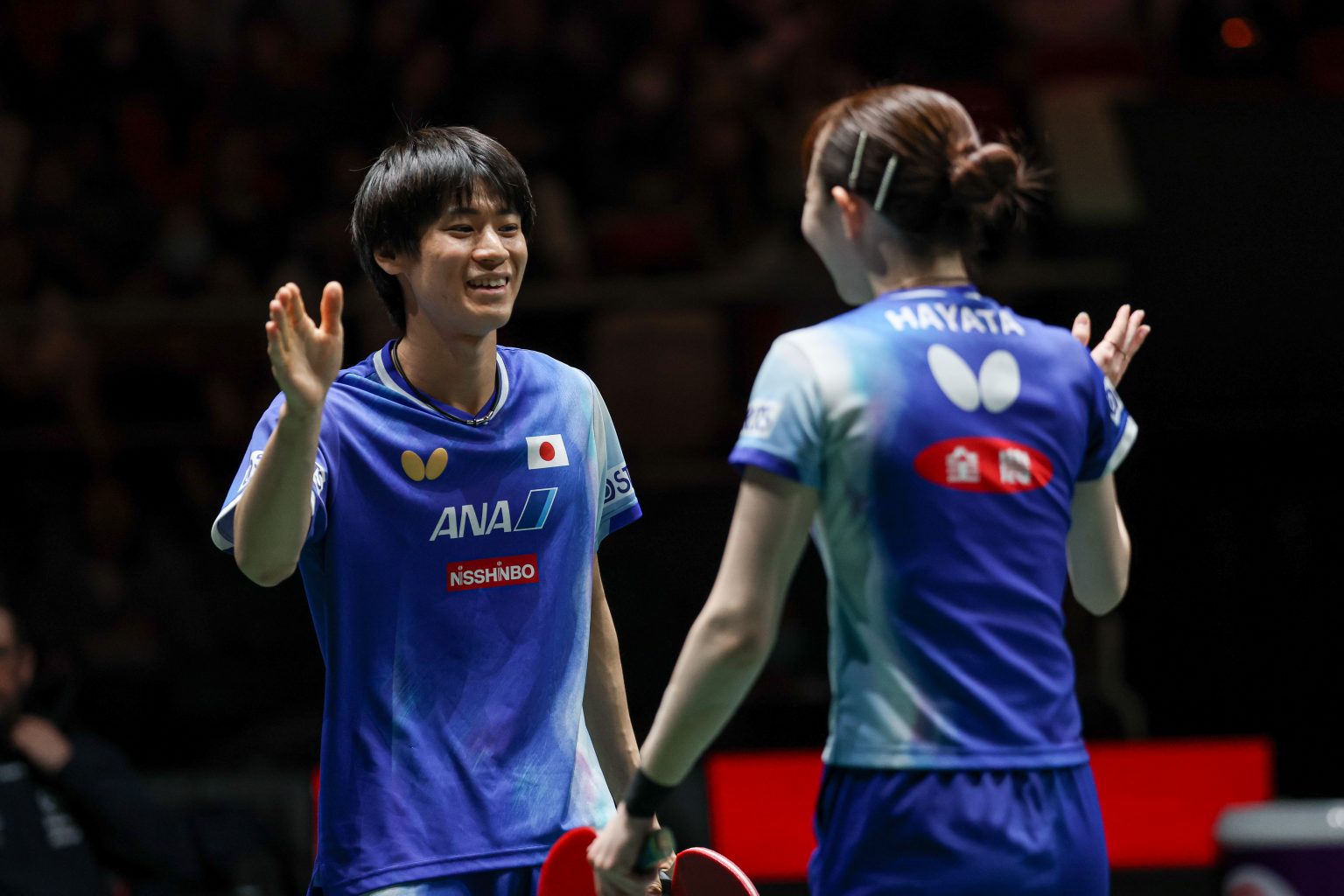
Japan. Shunsuke Togami and Hina Hayata (Photo ITTF)
The ITTF Mixed Team World Cup in Chengdu saw momentum building as teams including Japan and host China building the momentum towards qualification to the next stage.
Japan joined China as the only unbeaten team in the competition, as they beat fourth seeded Germany and followed it up with a victory over Sweden.
The started the day with 8-3 win over the Germans.
Germany took a calculated approach, shaping their lineup around past head to head results against the Japanese players. Annett Kaufmann was handed the women’s singles slot, rewarded for her victory over Miwa Harimoto at the Paris Olympics in 2024. For the men’s singles, the choice fell on Dang Qiu, who came in with confidence after his recent triumph over Tomokazu Harimoto at the WTT Star Contender in London earlier this year.
In the opening Mixed Doubles fixture, Sora Matsushima-Satsuki Odo teamed up to win 2-1 against Germany’s Benedikt Duda-Nina Mittelham. They won the first 2 games with relative ease to open up a 2-0 lead. But a lapse in focus, especially from Matsushima who went too aggressive, cost them the third game.
In the women’s singles Miwa Harimoto avenged her Olympic defeat to Germany’s Annett Kaufmann. Harimoto took charge from the outset, using her backhand flick to consistently neutralize Kaufmann’s serve. She also adjusted her positioning in rallies, standing more centrally than usual to blunt the angles Kaufmann sought to exploit as a left hander. The tactical shift proved decisive. Harimoto dismantled Kaufmann’s game plan point by point, closing out a straight sets 3–0 victory that swung momentum firmly in Japan’s favour.
With Germany trailing 1–5, a win was essential, and Dang Qiu delivered in the men’s singles. He confirmed that his earlier victory over Tomokazu Harimoto was no fluke, prevailing 2–1 to drag Germany back into the contest. Known more for consistency than power compared to his teammates,
Dang flipped the script by unveiling new dimensions to his game. Harimoto was forced to absorb heavy pressure as Dang Qiu controlled exchanges both on serve and receive, repeatedly striking his reverse pen-hold backhand down the line. Any loose return was met with a sharp step around forehand from close to the table, driven to both flanks to keep Harimoto unsettled. Even so, Harimoto managed to salvage the third game, securing a crucial point for Japan despite the overall loss.
But the spark of a German comeback was swiftly extinguished by Sora Matsushima-Shunsuke Togami in the men’s doubles. They imposed themselves early in the match, leaving Benedikt Duda-Patrick Franziska struggling to respond. Their dominance carried through both games, sealing a 2-0 lead that confirmed Japan’s overall win.
The Japanese had a much easier time in their opening match of the day, blanking Sweden 8-0.
The mixed doubles was the toughest fixture for Japan. Shunsuke Togami-Hina Hayata combined to survive a tough match against Sweden’s Anton-Christina Kallberg. Every game was separated by a mere margin of 2 points, with a marathon 18-16 in the first.
Mima Ito then made short work of Filippa Bergrand, who made her first appearance of the tournament. It was an absolute rout, as Bergrand made only 10 points in three games. Ito’s serve and flat forehand hits too much for the Swede, as she doubled Japan’s lead to 6-0
Sora Matsushima then finished the job, beating 2019 World Championships finalist Mattias Falck 2-0. An aggressive Matsushima was too much for Falck, who was making his first appearance of the tournament.
The day began with another dominant win for China as they beat Korea Republic 8-0.
Kuai Man-Lin Shidong set the tone in the mixed doubles, sweeping aside Korea Republic’s Kim Nayeong-Park Ganghyeon with a 2-1 win. The Korean duo fought hard in the second game, stretching Kuai Man-Shidong to 14-12, but the Chinese pair kept their composure and finished the match strongly in the third.
Momentum carried into the women’s singles, where Wang Manyu delivered a performance of complete control against Korea Republic’s Lee Eunhye. From the opening exchanges, Wang dictated the pace and direction, never allowing her opponent a foothold. The gulf in level between the two players becoming unmistakably clear as Wang sealed another 3-0 triumph.
The atmosphere inside the arena then reached its peak when Wang Chuqin stepped up for the men’s singles against Korea Republic’s An Jaehyun. The two, long-time rivals since their junior days, brought a sense of history to the contest. It was An Jeahyun who made the strong start, recovering well from an embarrassing service error in the first point to take a lead in the first game. Yet Wang remained composed, clawing back the deficit to take the opening game 11-9.
In the second game he took control early, building pressure and leaving little room for An Jaehyun to respond. The contest ended with a remarkable around the net forehand roller on match point, giving Chuqin 11-4 win and securing another clean sweep for China
The evening session opened with another commanding display from China, as they dismantled France 8-2 in what was their toughest match yet.
Wang Chuqin-Sun Yingsha handed France’s Alexis Lebrun-Jia Nan Yuan their first loss in the mixed doubles of this competition, winning 2-0. Only the second game was a close affair, going to 12-10, as Wang and Sun dominated the rest.
Wang Manyu then won in straight games against France’s Prithika Pavade. Despite the score line, France will take encouragement from the fixture as Pavade finally showed signs of returning to form. She gave Manyu a tough fight, losing 9-11 in the first and also holding a 10-8 lead in the second. But she failed to convert against the experienced Manyu , who held on to win the second game 12-10, and won comfortably in the third.
With a 7-0 lead going into the men’s singles, it was Liang Jing-kun who entered the arena to face France’s Felix Lebrun. Jing-kun, the most senior member of the Chinese men’s squad, stormed to a 11-6 win in the first game. It appeared to be another clean sweep for China, as Jing-kun led 10-6 in the second game as well. Yet Felix refused to give up, mounting an incredible comeback to win 13-11. With momentum fully on his side, Felix pressed home the psychological advantage, winning 11-7 in the decider. With the win, Felix handed China their first loss in the whole competition, forcing the 4th fixture for the first time.
Felix then joined brother Alexis in the men’s doubles to try and extend France’s comeback run. But it was not to be, as Wang Chuqin-Lin Shidong proved too strong. They won 11-9 in a tight one set showdown to complete the 8-2 win.
Meanwhile, Korea Republic shrugged off the loss against China earlier in the day to put up a convincing performance against Hong Kong, China.
Things did not start well for them though, as Wong Chun Tung-Doo Hoi Kem put behind their mixed doubles loss earlier in the day against Sweden to beat Korean’s Kim Na-yeong-Park Gang-hyeon. After dropping the opening game, the Hong Kong pair levelled the contest and then edged a tense decider 12–10 to hand their team the lead.
Lee Eun-hye restored momentum for Korea Republic, racing through her first two games against Zhu Cheng-zhu in the women’s singles. But Chengzhu managed a crucial win in the third game for Hong Kong keeping the tie balanced at 3–3.
It was senior Korea Republic star Jang Woojin’s time to shine, as he delivered a crucial 3-0 victory over southpaw Baldwin Chan. Woojin was at his best, using his fitness to unleash relentless forehand attacks and cover the table with ease. His straight-games triumph eased the pressure on Korea and pushed them into a 6-3 lead.
Chan, however, found redemption in the men’s doubles. Teaming up with Wong Chun Ting, the World No. 1 pairing showed their class with a 2-1 win over Park Gang-hyeon and Oh Jun-sung, clinching the decider 11-9 to keep Hong Kong in the contest.
Yet the comeback hopes ended there. Kim Na-yeong-Choi Hyo-joo, buoyed by the cushion of a 7-5 lead, dominated the women’s doubles. They swept past Zhu Chengzhu and Doo Hoi Kem 11-2, sealing Korea’s overall victory in emphatic fashion.
Meanwhile, German dominated Germany dominate Croatia to win 8-1 in their opening match.
Germany continued their policy of chopping and changing their lineups, with a new look German pair of mixed doubles Dang Qiu-Annett Kaufmann taking down Croatia’s Ivor Ban-Hana Arapovic.
Sabine Winter then continued the momentum, going virtually unchallenged as she won 3-0 against Mateja Jeger in the women’s singles to extend Germany’s lead to 6-0. Jeger had no clue on how to tackle Winter’s ‘anti spin’ backhand rubber, and Winter punished her with her step around forehand on multiple occasions.
Benedikt Duda then stepped up to finish the job in the men’s singles. With a formidable 13-1 head-to-head record against Tomislav Pucar, he leaned on that advantage to edge a tight contest 2-1, clinching the decider 12-10 and sealing Germany’s emphatic 8-1 win.
The morning session also saw Hong Kong, China survive alate Sweden comeback, to win 8 – 6.
Kristian Karlsson-Christina Källberg gave Sweden a dream start in the mixed doubles against Hong Kong, China’s star duo of Wong Chun Ting-Doo Hoi Kem. An aggressive Karlsson, unleashed his backhand to telling effect, while Kallberg’s consistency ensured the pair barely missed a beat. Together they took the opening game. At 10–9 in the second, Kallberg produced a superb heavy backspin serve that drew an error from Wong on the receive, sealing a 2–0 lead. Although Wong and Doo fought back to claim the third, the Swedes had already secured an excellent result.
Momentum was firmly on Sweden’s side, but Zhu Chengzhu produced a clinical performance against the in form Swedish chopper Linda Bergstrom. Zhu’s strategy was deliberate: she played with low quality topspin, reduced spin and pace, forcing Bergstrom to exert far more effort from her deep court defensive position.
The approach drew a higher rate of errors than usual from the Swede, steadily tilting the match in Zhu’s favour. As Bergstrom searched for answers, Zhu shifted tactics in the third game, this time unleashing her power to disrupt rhythm and deny any chance of adjustment. The change in tempo completed a comprehensive straight sets win, a huge result for Hong Kong, China.
It was then Lam Siu Hang against Sweden’s Anton Kallberg in the Men’s Singles, a fixture the Swedes had marked as a likely win. Kallberg lived up to expectations early, overwhelming Lam in the first two games to race into a 2–0 lead. Yet the finish proved frustrating. Holding a 10–7 advantage in the third, Kallberg faltered and let the game slip away, handing Lam and Hong Kong, China a crucial point despite the overall victory.
Th Swedes continued to falter as Hong Kong, China’s World No. 1 pair of Wong Chun Ting and Baldwin Chan won against Sweden’s Anton Kallberg and Kristian Karlsson. They edged a tense opening game 15–13, then followed up with an 11–8 win built on Wong’s age defying acrobatic forehands and Chan’s steady presence. Kallberg and Karlsson did manage to strike back in the third, pulling a game to keep Sweden’s hopes alive, but Hong Kong, China now led 7-5.
But what followed was pure theatre. Sweden’s Linda Bergstrom and Christina Kallberg put up a fightback for the ages, winning the first game 11-8 in the Women’s doubles against Zhu Chengzhu and Ng Wing Lam. They started brilliantly in the second game as well, opening up a 3 point lead. But Zhu and Ng managed to rally and win the second game 13-11, sparking jubilant celebrations in the Hong Kong, China bench.
Sweden will walk away ruing their missed opportunities in this matchup. The straight sets defeat suffered by an in form Linda Bergstrom in the Women’s Singles, coupled with Anton Kallberg’s failure to close out a 10–7 lead in the third game against Lam Siu Hang proved too costly. They need to regroup quick to stay alive in Stage 2.
France bounced back strongly from their agonizing loss to Korea Republic the night before, producing a convincing 8-3 victory over Croatia.
Simon Gauzy marked his first appearance of the tournament by partnering Prithika Pavade in the Mixed Doubles. The pair fought through a tight contest, edging Croatia’s Ivor Ban and Hana Arapovic 2-1. With the score level at 1-1, Ban looked close to turning the match in Croatia’s favor, but Gauzy and Pavade kept their nerve and sealed the decider 16-14 to give France the lead.
Charlotte Lutz then made her first appearance of the tournament, delivering an impressive performance to defeat Croatia’s Lea Rakovac. Showcasing a noticeably sharper forehand topspin, she used it to telling effect throughout the match. After edging the opening game 13-11, Lutz grew in confidence, winning the next two to win 3-0.
Alexis Lebrun then took on Croatia’s Tomislav Pucar in the Men’s singles. He had a tough start in the Men’s singles, dropping the first game. Pucar made effective use of the ‘TTR’ system, twice challenging Lebrun’s serve for a faulty ball toss, with both reviews upheld to give him two extra points that proved decisive in a 11-8 win. However, Lebrun kept his cool. Making the necessary change on his serve, he dropped only 7 points in the next 2 games as he beat Pucar 2-1.
With France leading 7-2, Charlotte Lutz and Prithika Pavade faced Croatia’sLea Rakovac and Mateja Jeger. They began well, leading in the first game. But Rakovac produced a stunning ‘behind the back’ winner that shifted the momentum and carried the Croats to an 11-9 win. The second game appeared to be unfolding in similar fashion, with Lutz and Pavade again letting their lead slip. But they steadied themselves just in time to win the second game 11-9, completing France’s win