



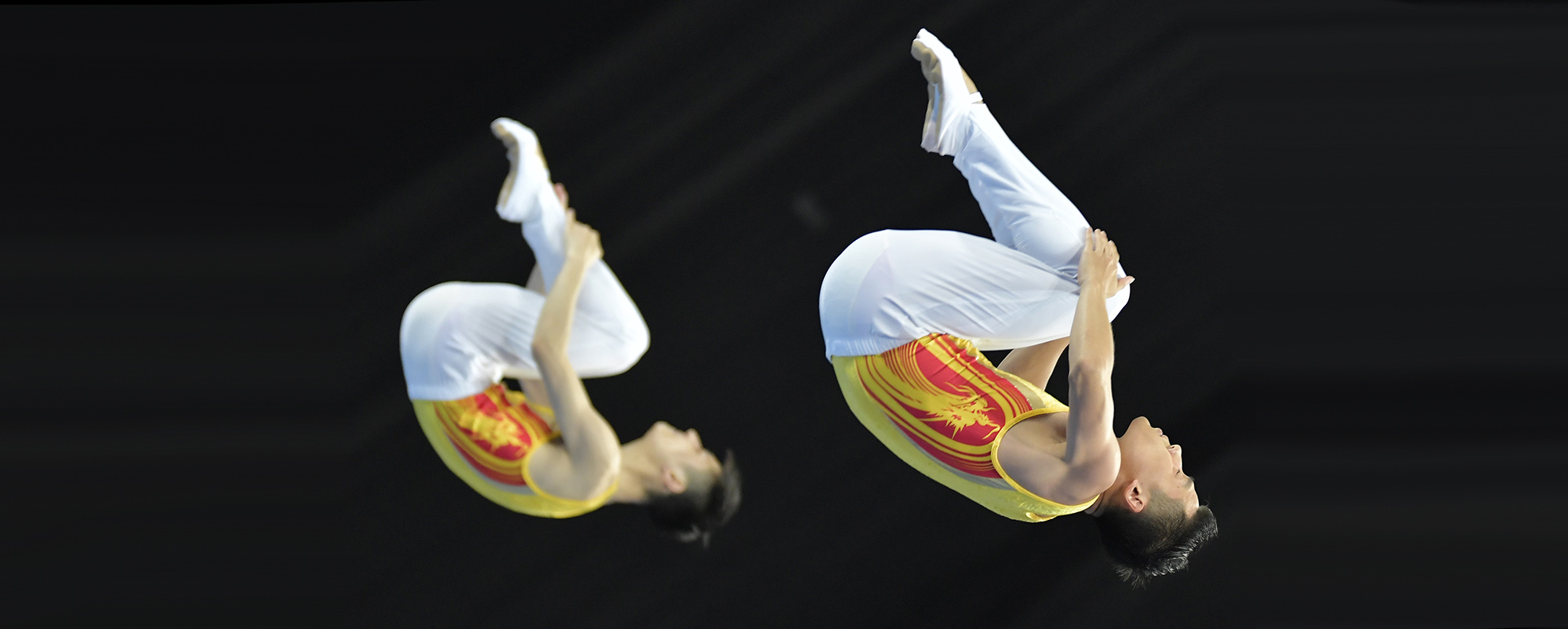
It was USA all the way in Double Mini-trampoline, while seasoned teams led by reigning world champions brought both France and Azerbaijan their second team Tumbling titles in four years as finals got underway at Pamplona’s Navarra Arena.
U.S. gymnasts stayed cool to collect team golds in men’s and women’s Double Mini-trampoline (DMT) — when they were performing, anyway. Off the competition floor, they danced and joked and celebrated every terrific performance with all the exuberance of youth.
They had a lot to celebrate. Top-drawer difficulty already set both U.S. teams apart in Thursday’s individual qualification, and all the Americans needed to do was hit in the finals to walk out as world champions. In the finals, they seized control in a competition where the best performance in each of three rounds earned maximum points for the team.
The unique format essentially makes each round into a mini-final where one appointed competitor from each team performs and the highest scorer earns the maximum number of points for his or her team. This proved no problem for the American men (Trevor Harder, Simon Smith, Ruben Padilla and West Fowler) who amassed 28 of a possible 30 points, putting them well ahead of Australia (Nicolas Diaz Ballas, Troy Sitkowski, Rohan Wilcox and Matthew French) and a squad of neutral athletes including Mikhail Zalomin, who earned his 13th world medal with bronze.
Trevor Harder, the top qualifier in men’s qualification Thursday, set the tone by nailing his opening pass, a triffis pike to half in triple pike half out. “I usually don’t show too much emotion when I do my landings but this one I just couldn’t hold back,” Harder said. “I wasn’t just flipping out there for myself, I was flipping for my team, for Team USA, and it was incredible.”
Smith showed a tucked version of Harder’s opening pass, and Padilla capped things off with a triffis pike to triple pike combination that seemed to hover somewhere near the arena ceiling before coming slowly back down to Earth.
In the women’s final, excellent runs from Aliah Raga and Kennedi Roberts, accompanied on the sideline by Susan Gill, set the stage for Grace Harder to bring home the gold. Harder, who struggled in the individual qualification, felt she had something to prove. A long wait before receiving the judges’ signal gave her time to process it all. She went on to nail the pass of her life, securing each of her team members their first world title.
“It means so much to me that I was able to hit the pass after how prelims went. I was so knocked down,” an emotional Harder said afterward. “I definitely [had something to prove]. And I freaking crushed it.”
Strategic performances from Kirsty Way, Kim Beattie and Molly McKenna, accompanied by Emily Lock, brought Great Britain silver, while Melania Rodriguez surprised herself by sticking her landing in the final round and bringing Spain the maximum number of points, propelling them from fifth place all the way to bronze.
French tumblers good as gold in second title run
Four years ago Maelle Dumitru-Marin (FRA) was the replacement athlete for the final as the French women won their first team Tumbling world title since 1996. On Friday Dumutru-Marin was the gymnast who sealed France’s second.
France was only fifth of eight teams after the first round in the women’s Tumbling final. They got a boost from reigning world champion Candy Briere-Vetillard, who showed a superb sequence that strings together double layout, double tuck, and double pike somersaults. The only gymnast in the competition to do three double-somersaulting elements in a single pass, Briere-Vetillard earned the maximum number of points in her round, putting France back in the gold medal game.
Up stepped Dumitru-Marin, who delivered a critical score in her round with her double layout through to full-in double pike.
“It’s really good for me because I had a hard time accepting that I was the fourth gymnast on the team the first time,” Dumitru-Marin said. “It was my first World Championships, and now I have more experience and a greater perspective. So this medal at this championships is more meaningful as a result.”
Excellent passes from first place qualifier Megan Kealy as well as Naana Oppon and debutant Jaeda-Lei Jeffers helped Great Britain earn silver. A 25.0 in the final round by 17-year-old rising star Lani Spiessens (BEL) brought bronze to a well-rounded Belgian team that includes twins Fran and Marth Renders and Sara Neyrinck. A single point separated each team: France ended with 18, Great Britain 17, and Belgium 16.
The Azerbaijani men (Tofig Aliyev, Adil Hajizada, Mikhail Malkin and Bilal Gurbanov) who won their first World title in 2023, returned three of four members of that gold medal team as they powered ahead of the USA and Denmark in a final filled with jaw-dropping acrobatics.
World champion Mikhail Malkin (AZE) got things underway for the team with a focused pass that ended with a triple tuck. Aliyev added a full twist to his triple back dismount, though it was not enough to best World Games champion Kaden Brown (USA), who showed three variations of the classic double layout in the round’s best scoring run. After two the USA and Azerbaijan were in a dead heat with 16 points apiece, setting up a head-to-head between Hajizada and Xavier Harper that would determine the gold.
Though both men performed similar passes capped by the ubiquitous triple-twisting double layouts, Hajizada’s was made more complex by the addition of whip backs, which gave him the edge in difficulty. The difference was just over a point: Hajizada’s 28.100 compared to Harper’s 27.000 assured Azerbaijan the points it needed to finish with 26 to the U.S’s 22.
“It was a hard competition but under our control. We made good decisions for ourselves, and it brought us this medal,” Aliyev said. “We wanted this medal a lot after 2023. It was our next dream to win a gold medal at the next World Championships after that one.” The team is already counting a three-peat next year, he added.
Bolstered by daringly difficult passes, Denmark’s Magnus Lindholmer, Martin Abildgaard, Marius Bundgaard and Frederik Skaaning won their second consecutive team bronze with 18.
Hu and Zhang the pair to beat in Synchronised Trampoline
Synchronised Trampoline pairs get two chances to perform a routine well in the first qualification round, where the best of the two scores is the one that counts. The rules tighten in the second qualification, where everyone goes once and every score matters. This is when the audience and judges see who has the tenacity to perform under pressure.
Even the more lax format got the better of a few acclaimed pairs, including World Games champions Lucas Santos and Gabriel Albuquerque (POR) and bronze medallists Sophiane Methot and Sarah Milette (CAN) early Friday. 2023 World champion Sarah Webster and new partner Jessica Stevens (USA) were eliminated in the second qualification.
Hu Yicheng and Zhang Xinxin (CHN) had no such problems. The Chinese duo was nothing but superb through its three qualification routines, topping the standings after both the first and second rounds. Though two other pairs broke the 50-point barrier during the first qualification, Hu and Zhang were the only ones to do it in both rounds. Anzhela Bladtceva and Sofia Aliareva (AIN) were second in round two, followed by Mori Hikaru and Tanaka Saki (JPN).
The Chinese men’s path was not as smooth, though Wang Dong and Chen Yuhan, the top finishers from the first round, are through to the final. The second qualification round was won by Olympic champion Ivan Litvinovich and Andrei Biulou (AIN) ahead of Matsumoto Yusei and Miyano Hiyano (JPN).