



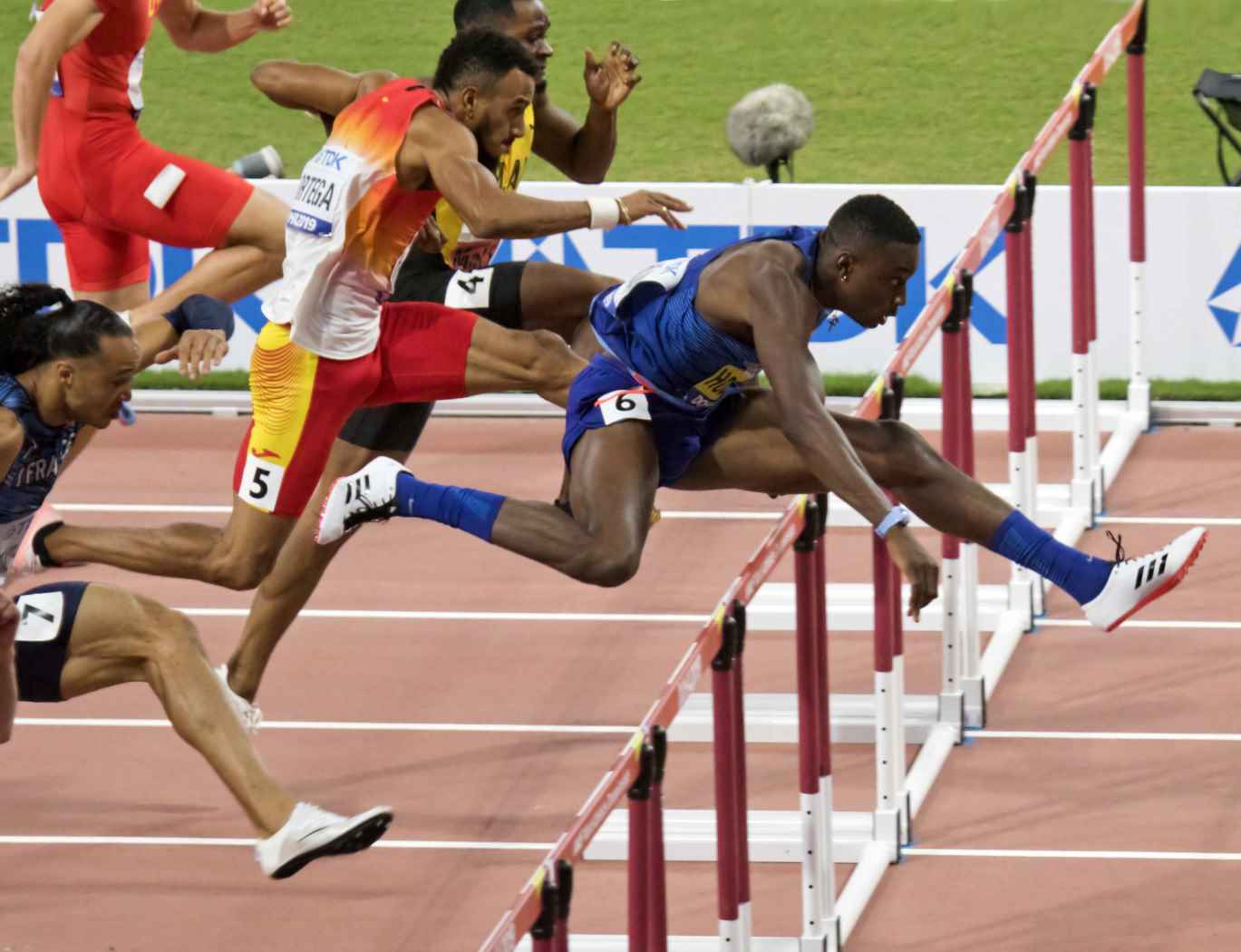
Holloway (R) en route to the 110 m hurdles title at the 2019 World Athletics Championships in Doha, Qatar. (Photo by filip bossuyt)
It has been a season to forget for the reigning 110m hurdles Olympic champion Grant Holloway. But his rivals would be warned to write off the US athlete at their peril at the World Athletics Championships in Tokyo, such are his championship credentials.
You have to go all the way back to London in 2017 for the last time that Grant Holloway didn’t win the world title in the 110m hurdles.
While he has struggled, others have shone – the top eight on the entry list either setting or matching their personal bests so far this season.
Of those, Holloway’s compatriot Cordell Tinch has undeniably been the class act. Signed to a football scholarship initially at college in the United States, by his own admission he struggled with the weight room so sought out a sport he thought needed less of that.
He found himself in track and field where he excelled in three disciplines: the sprint hurdles, the high jump and the long jump. He has PBs of 2.21m in the high jump and 8.16m in the long jump to show he was no slouch in those.
But judging by his form this season, he was right to focus on the 110m hurdles, and he ran the joint fifth-fastest time in history in China back in May, a time of 12.87.
He looks the likeliest contender to deny Holloway a fourth straight world title, and yet Japan can have very realistic ambitions for a home gold in the event.
Like Tinch, Rachid Muratake – a finalist at last year’s Olympics – is hitting his strides at just the right time, having run a Japanese record of 12.92 just last month, putting him joint 11th on the world all-time list.
There is a third sub-13-second man in the field in France’s Just Kwaou-Mathey, who became only the fifth European athlete in history to dip below that barrier when he achieved the feat at the French Championships in Talence at the start of August. All of the other athletes on that sub-13.00 list have gone on to become either world or European champion.
The women’s 100m hurdles will be highly competitive, with 10 of the 14 fastest athletes in the world this year among those colliding.
These hurdlers, who have gone head-to-head throughout the season, have blown the field open, with seven different winners across the Diamond League meetings. Only USA’s Grace Stark has won three, while Jamaica’s Ackera Nugent has won two. That demonstrates the incredible depth and unpredictability in the event.
Olympic champion Masai Russell is the world leader and she heads to Tokyo with the second-fastest 100m hurdles of all time to her name – 12.17 set in May – and that forms part of a packed season of 24 races that began in January. Her win at the US Championships was followed by victory in Silesia, where she set a Diamond League record of 12.19, and she then finished runner-up to Nadine Visser in Lausanne – her final race ahead of Tokyo. The 25-year-old has rebounded in great style after the fall in Budapest that kept her out of the World Championships final in 2023 and, after her win at the Olympics in Paris, she has the chance to go for gold again on the global stage.
One athlete who could pose a serious challenge to Russell is her compatriot Stark, who was fifth at the Paris Games. On top of the world rankings and third on this season’s top list with a PB of 12.21, Stark has notched victories this season in Shanghai/Keqiao, Stockholm and Paris, where she stormed to a third Diamond League meeting record of the season and that PB.
There’s also the experienced defending champion, Danielle Williams from Jamaica. Williams, who claimed her first world title in 2015, won the Xiamen Diamond League before setting a PB of 12.31 for a fourth-place finish in Silesia.
Her compatriot Nugent took down some big names in Eugene and at the Diamond League Final in Zurich to claim her first Diamond League title. That performance will have been a major confidence booster for the 2021 world U20 champion, who finished fifth at the World Championships in Budapest. Nugent’s season best is 12.30.
Nigerian hurdler Tobi Amusan has a chance to reclaim the title she won in 2022 in Eugene, where she clocked her world record of 12.12. The 28-year-old, who finished sixth at the last edition of the World Championships in Budapest, won in Rabat with a season’s best and meeting record of 12.45. She was runner-up in both Paris and Eugene, and claimed victory at the Ostrava Golden Spike in between.
Can anyone deny Femke Bol a second consecutive world title in the 400m hurdles at the World Athletics Championships Tokyo 25?

In the absence of the Olympic champion and world record-holder Sydney McLaughlin-Levrone, who has opted for the 400m flat this time, it seems unlikely if the 25-year-old Dutch athlete maintains her standard.
Bol has so far put together a perfect season over the quarter-sticks, winning eight successive races in Rabat, Hengelo, Stockholm, Monaco, London, Budapest, Silesia and Zurich. She has barely been troubled in compiling that magnificent eight.
Rio Olympic and Doha world champion Dalilah Muhammad, 35, who intends to retire this year and has been close to career-best form this season, with a best run of 52.58. She will be Bol’s biggest rival.
The three fastest 400m hurdlers in history renew their rivalry in Tokyo. World record-holder Karsten Warholm defends the title and starts as the world leader. Alison dos Santos seeks to regain the crown, while Rai Benjamin looks to win it for the first time.
The three athletes have built a rivalry that has taken their event into a new era.
Norway’s Warholm is the world record-holder with 45.94 from the Tokyo Olympics, USA’s Benjamin was second in that Olympic final in 46.17 and claimed the Olympic crown in Paris, while Brazil’s Dos Santos ran a championship record of 46.29 when winning the 2022 world title in Oregon.
It has been like this for years. Now they return to Tokyo, four years on from that magnificent Olympic clash in an empty stadium due to the pandemic. They are ready to put on another show, this time with a crowd to watch.
Warholm arrives in Tokyo with the world-leading time. He clocked the third-fastest time in history – 46.28 – at the Wanda Diamond League meeting in Silesia, just weeks before the World Championships. It is a time that only he and Benjamin have ever beaten.