


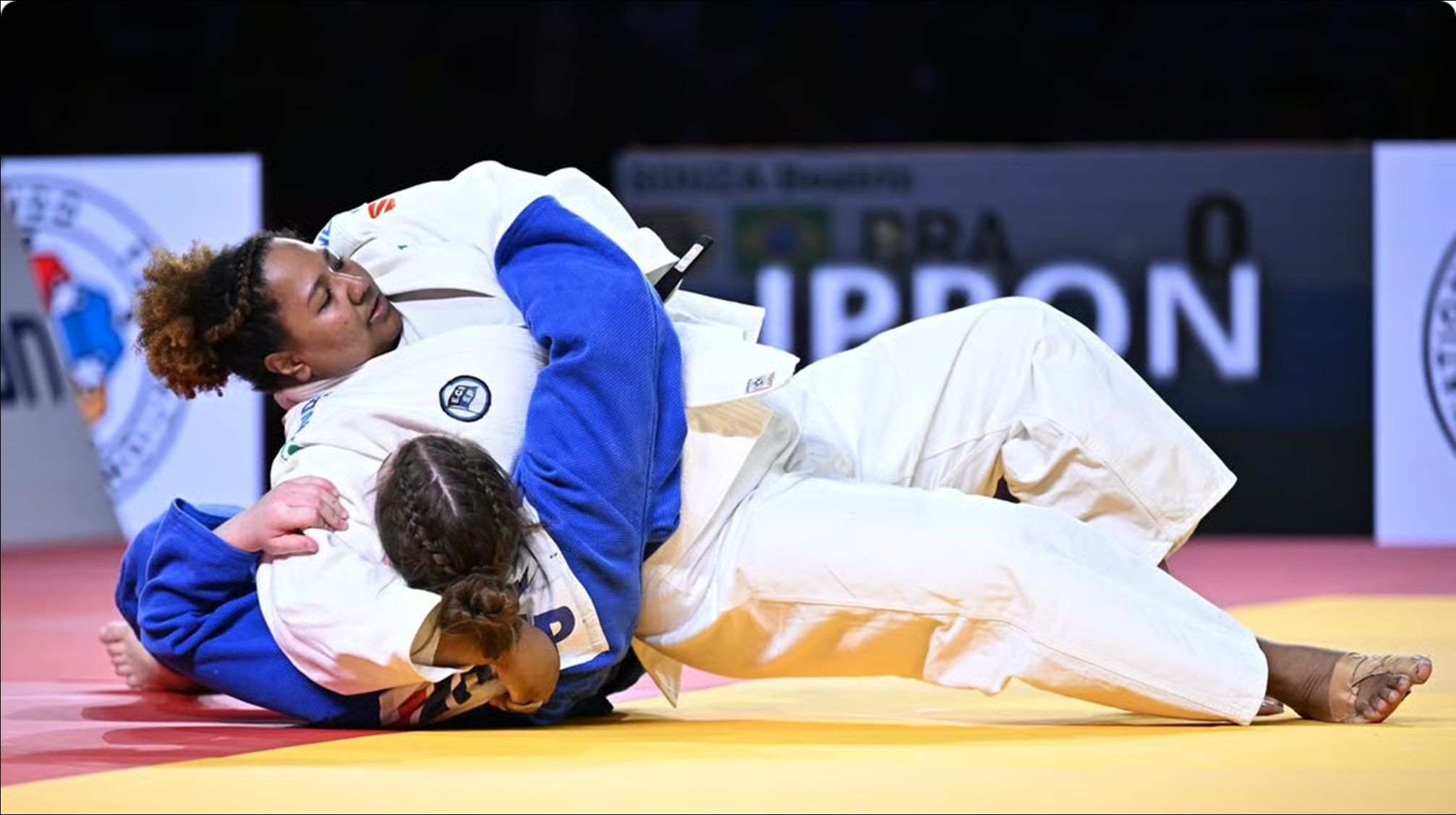
The winning throw from Beatriz Souza (Photo by Emanuele Di Feliciantonio, Tamara Kulumbegashvili)
The Brazilian team gave a stellar overall performance winning at least one gold medal on each day of competition at the Zagreb Judo Grand Prix. Brazilian men and women, lightweights and heavyweights, the team excelled, throwing their way to being the best nation of there event. Olympic champion Beatriz Souza capped the team’s offering by throwing New Zealand’s Sydnee Andrews in the +78 kg final
Lea Fontaine of France and Olympic champion Souza held up their end of the bargain when they reached the semi-final of the top half of the draw of the women’s +78kg category. Seeded first and fourth, they sliced through the rest of pools A and B to ensure they would each appear in the final block.
Souza, still in great form after Abu Dhabi, countered Fontaine with an uki-otoshi for a yuko, the only score of the contest, to book her place in the final. Who she would face was a big surprise as the bottom half of the draw didn’t follow the expected hierarchy.
Andrews, New Zealand’s current Commonwealth champion was the best of pool C after a quarter-final win over Croatia’s number two seed Helena Vukovic. It was an inspired performance all day from Andrews who committed all her energies to each fight in turn.
In her semi-final she faced Rochele Nunes of Portugal, who had also beaten the highest ranked athlete in her pool, but she couldn’t pass Andrews in Zagreb.
In the first minute of the final, Andrews engaged fully with the task in front of her. Fighting a current Olympic champion is no joke but Andrews wasn’t fazed. Smaller and very mobile, she began with a dynamic entry into an osoto-gari. There was no score but she continued in the same way in the second exchange. There was still no score but Souza was gong to need to accelerate to avoid being penalised.
As the first minute ticked by, Souza made her play and spun herself into a powerful, controlled hare-gosh. She scored ippon to end the contest and ensure she would stand on the top of the podium.
Although she finished her day with silver and not gold, Sydnee Andrews was happy to speak about her best ever result on the World Judo Tour, “I had the mind set of having nothing to lose. I had to give it my all and empty the tank completely. The back patch isn’t intimidating. Everyone is the same out there. I knew I was coming home with a career-best result and so I went out to enjoy it and do my best.”
Hoelterhoff continues Germany’s -78 kg tradition
Kaila Issoufi of France arrived as the top seed in the women’s -78kg and was therefore expected to cause ripples. In her first contest she defeated 2023 world champion Inbar Lanir of Israel and looked ready to impose herself on the category. However, that was without accounting for Julie Hoelterhoff.
The 28-year-old German judoka had only two World Judo Tour bronze medals on her CV prior to Zagreb, both won in 2025. In Croatia she stepped up to a new level and improved her record, doing so in a high quality field. She beat Issoufi in their quarter-final contest and then defeated 2024 world bronze medallist Emma Reid if Great Britain in the semi-final stage.
On the other side of the draw it was Elena Dengg of Austria who came through, beating Elvismar Rodriguez of Venezuela in the semi-final to book her place in the gold medal contest with Hoelterhoff.
In the final, an all-action battle took place. Dengg was ready to attack in every exchange but her German opponent was ready with the counters. Two of them scored, a yuko each, putting Dengg under pressure. As the clock ticked down to zero, it was clear the Austrian would not be able to get the scores back and Hoelterhoff could celebrate an excellent win on the Croatian stage.
After the final Julie Hoelterhoff said, “Winning this grand prix is an unbelievable feeling after doubting my capabilities at 28 and facing tough competition in Germany. Training every day with my partner and top competitor Anna-Maria Wagner is helping me get stronger; I look forward to next year.”
Schimidt holds pole position
Ranked 6th in the world, Brazil’s Guilherme Schimidt delivered a great performance to slide through the men’s -90 kg category with little resistance, aside from a comeback moment in his semi-final. He finished every contest before the allotted four minutes was over to set up a final against Olympic medallist Theodoros Tselidis of Greece, the third seed.
The final consisted of physically demanding exchanges and the highest level of tactical mastery, each judoka neutralising the other. Going into the last minute of the fight there were two penalties apiece and the distinct feeling that either could hunt down a score at any moment. Eventually, with ten seconds of the contest left, it was Schimidt who set up an outstanding de-ashi-harai. He dragged Tselidis’ front foot out from under him and registered a waza-ari. Schimidt has a new gold medal to add to his collection!
After the final Schimidt said, “I am very happy today, bouncing back from a disappointing world championship to win my first grand prix gold medal in Zagreb, the place where I won my first World Judo Tour medal, in 2021 and twice finished. The semi-final and final were tough fights; I came back from a waza-ari down in my semi-final before defeating an Olympic medalist in the final, a victory I dedicate to my late first coach who always told me to fight with heart. This marks my sixth consecutive Tour medal this season, showing that the Brazilian team is turning things around after a tough worlds.”
Savytskiy keeps his promise
Being at the top of the draw can be seen as a promise to be the best on that day but, as we know, that is often not the case. The dynamism of judo delivers surprises and twists at every tournament. This was the case in Zagreb but not for Ukraine’s Anton Savytskiy in the men’s -100kg category.
Pool B in Zagreb included Michael Korrel of the Netherlands, Daniel Eich of Switzerland and -90 kg double world champion Nikoloz Sherazadishvili of Spain. One of them was likely to find themselves in a semi-final with Savytskiy and, sure enough, it was Eich. Their semi-final stayed close until the last 20 seconds when a koshi-guruma gave the Ukrainian judoka an impassable lead.
On the other side of the draw, Dzhafar Kostoev of the United Arab Emirates was the man to beat. On the way to the second -100 kg semi-final he defeated world champion Jorge Fonseca of Portugal, among others, but in the semi-final he came unstuck against Zsombor Veg of Hungary.
In the final Anton Savytskiy seemed to have magic in his feet. His ashi-waza work was incredible to watch, especially the ko-soto-gari he used for a first yuko and then a second score which was ippon. His timing, use of combinations and power all came together to produce an outstanding day of judo.
After the final Savytskiy said, “My mentality is always strong and focused to win no matter what. After fighting a tough opponent from Hungary, our second match in two weeks after Abu Dhabi, winning gold in Zagreb again is wonderful; it’s a beautiful city with great people. To rise to the top in the tough under -100 kg category takes hard work and doing your best in training. Today I’m the winner but next is the preparation for the World Judo Masters, where I hope to finally win a medal in Tajikistan.”
Nasibov nails it
Ushangi Kokauri has had a fantastic few weeks winning a silver in the men’s +100kg at the Baku World Championships and another at the Abu Dhabi grand Slam. In Zagreb he began the same way but a loss against Losseni Kone of Germany in their semi-final cost him another final but also left him needing to withdraw due to injury.
Kokauri’s teammate did go all the way though; Kanan Nasibov has also been in great form lately and took his own world championship bronze in Baku. In Zagreb, Nasibov had to dig as deep as anyone could to win tactical marathon’s. He showed outstanding commitment and worked his way into the final.
In the final, Kone and Nasibov each employed a cautious strategy, not wanting to hand the other the victory. With two penalties on each side of the board, it was Nasibov who chose to break the rhythm. He drove Kone to the ground with a full contact o-uchi-gari to score a waza-ari and ensure the gold was his.
After the final, Kanan Nasibov declared, “I came here as the title holder and have become the champion once again. I feel very happy! When I came here I said that I would become the Zagreb Grand Prix champion for the second time and I stood by my word and did it.”