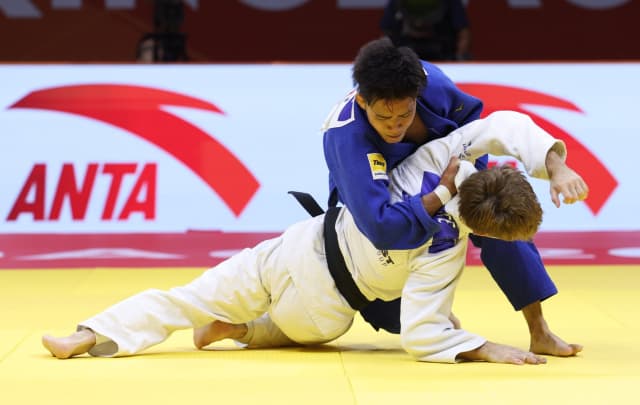
Hayato Kondo secures gold in the -60 kg category, (Photo by Emanuele Di Feliciantonio)
Japan once again demonstrated the remarkable depth of its team at the Qingdao Grand Prix judo championships. Hifumi Abe reminded the judo world why he remains one of the sport’s greatest champions, extending his extraordinary unbeaten run with another commanding display. Hayato Kondo combined tactical intelligence with clinical efficiency to secure gold in the -60 kg category, while Kokoro Fujishiro showcased outstanding transition skills to claim the biggest title of her career.
The opening day also produced several memorable milestones. Maysa Pardayeva of Turkmenistan wrote a remarkable chapter for her country by winning the first grand prix gold medal of both her career and Turkmenistan’s history.
The host nation was rewarded for its unwavering support as Wenna Zhuang delighted the home crowd by capturing China’s first gold medal of the tournament. After several of her teammates had fallen short of the podium’s top step, she held her nerve when it mattered most, producing a confident and determined performance that sparked celebrations inside the arena.
Fujishiro finishes strong to strike gold in Qingdao
One week can make all the difference. After finishing only seventh in the women’s -52kg at the Ulaanbaatar Grand Slam, Mascha Ballhaus of Germany arrived in Qingdao determined to prove that her performance in Mongolia had been nothing more than an off day.
She made her intentions clear from the outset. An ippon by osaekomi-waza against Fatjona Kasapi of Kosova provided the perfect start before she defeated Kenya Perna of Italy with two yuko, the first coming from a beautifully executed o-uchi-gari and the second from a hold-down.
Ballhaus’ momentum continued in the quarter-final, where Julie Weill Dit Morey of France was dispatched in just sixteen seconds. In the semi-final, Gultaj Mammadaliyeva of Azerbaijan resisted for much longer but eventually succumbed to another Ballhaus ippon during golden score.
The opposite half of the draw proved considerably more unpredictable, with favourites and outsiders exchanging victories throughout the day. In the end, Fujishiro emerged from the battle to book her place in the final against the impressive German.
The final remained finely balanced for much of the contest. Ballhaus held a slight advantage in the standing exchanges, while Fujishiro repeatedly looked to capitalise in ne-waza whenever the opportunity arose. With less than a minute remaining, the Japanese judoka combined both aspects perfectly. A powerful sode-tsuri-komi-goshi earned her waza-ari before she immediately followed the attack into kansetsu-waza, forcing the submission for ippon. It was a superb demonstration of transition judo and it secured Japan’s second gold medal of the day.
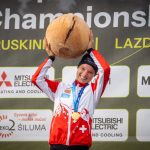
Stepping off the tatami, Fujishiro said, “I am incredibly happy. Although I have won other tournaments before, this is my first grand prix title. Looking ahead to the Olympic Games Los Angeles 2028, the selection process is not yet completely clear, so my goal is simply to perform consistently well at every competition and continue building my ranking step by step. I know Uta Abe is an exceptionally strong athlete in my weight category and always aims to win, but I am determined not to lose. My focus is on winning my own contests and becoming stronger every day. To help me do that, I always travel with my lucky charm, a doll called ‘Yuki-chan’. She feels like a friend to me. Having her by my side gives me confidence and helps me stay calm before my contests.”
Kondo takes gold after day of surprises
The men’s lightweight (-60kg) category produced its fair share of surprises from the very beginning. Top seed Balabay Aghayev of Azerbaijan was stopped by Olympic champion Yeldos Smetov of Kazakhstan, who looked increasingly comfortable as he continues his return to top-level competition.
Smetov’s run, however, came to an end in the next round. France’s Enzo Jean produced a determined performance, prevailing after a long and hard-fought golden score contest to eliminate the Kazakh star. At that point, it seemed Jean might have cleared the biggest obstacle standing between him and the final, but the day still had more surprises in store.
In the semi-final, the Frenchman encountered Charlie Ayre of Great Britain, an outsider ranked only 96th in the world and without major results on the World Judo Tour. Rankings, however, meant very little once the action began. Ayre produced judo of exceptional quality, combining relentless attacking intent with remarkable composure. Once again, Jean was taken into golden score, but after another epic contest it was the Briton who secured the biggest result of his career by reaching his first grand prix final.
In the opposite half of the draw, Kondo was not among the pre-tournament favourites despite being seeded. The Japanese judoka nevertheless progressed with intelligence and consistency, defeating Ahmad Yusifov of Azerbaijan in the quarter-final before overcoming Ayub Bliev of Russia to earn his place in the final.
The gold medal contest remained finely balanced until the closing minute. Kondo had enjoyed the upper hand in the gripping exchanges but had been unable to break through Ayre’s resilient defence, the Briton repeatedly managing to recover from dangerous situations. With less than a minute remaining, the Japanese judoka finally found the opening, countering powerfully for waza-ari. Moments later, he followed the action into ne-waza, securing an osaekomi-waza that sealed the victory and the gold medal.
After the final, Kondo said, “Winning the gold medal means a lot to me, especially seeing how happy it made my coaches. However, this is only the beginning of my Olympic qualification journey. I didn’t focus on winning today; I simply approached each contest as I would a normal training session to stay steady. Although defending my title from last year gives me great confidence, there is no time to celebrate. My focus is already on the Asian Games, the world championships and, ultimately, the Olympic Games Los Angeles 2028. I have to build on this momentum, keep training hard and continue striving to reach the very top.”
Hifumi Abe extends his reign
The question before the men’s -66kg competition was simple: who could stop four-time world champion and double Olympic champion Hifumi Abe? The answer proved equally straightforward. Nobody.
It was not through a lack of effort from his opponents. Quite simply, Abe once again demonstrated why he is regarded as one of the finest judoka of his generation. Apart from a bronze medal at last year’s world championships in Budapest, the Japanese star has remained virtually untouchable for years. Since claiming bronze at the 2019 World Championships in Tokyo and the defeat in Budapest, he has not suffered a defeat on the international stage. It is an extraordinary record.
Throughout the day, Abe never looked seriously troubled, controlling every contest with the calm authority that has become his trademark before advancing to yet another final.
Behind him, the battle for the second place in the final was far more unpredictable. Several favourites fell along the way and, after a succession of upsets, Gusman Kyrgyzbayev of Kazakhstan and Brazilian Ronald Lima emerged from the chasing pack. Ultimately, it was Kyrgyzbayev who earned the right to challenge Abe for gold.
The final proved considerably closer than any of Abe’s previous contests, which was hardly surprising given that it brought together the two standout judoka of the day. Kyrgyzbayev never stopped searching for an opening, but Abe’s mastery of the contest once again shone through. The Japanese champion eventually secured victory by a single yuko. Beyond the scoreline, it was the way he controlled every aspect of the contest that impressed most.
Combining flawless movement, impeccable timing and outstanding defensive awareness with remarkable physical strength, Abe remains extraordinarily difficult to throw while constantly creating scoring opportunities of his own. It was Japan’s third gold medal of the day and yet another demonstration that Abe remains the man to beat.
Home glory as Zhuang claims China’s first gold in Qingdao
All eyes were on world number one Hui Xinran of China, who looked well placed to deliver an opening medal for the host nation in the women’s -48kgand, ideally, the first gold of the tournament. After receiving a first-round bye and overcoming Lee Yoo-jin of Korea comfortably, Xinran appeared to be on course until she met Kristina Dudina of Russia in the quarter-final. There, her hopes of standing on the top step of the podium came to an abrupt end.
The disappointment continued for the home crowd in Pool B, where Xie Hongyan of China also saw her campaign stopped at the quarter-final stage, defeated by Türkiye’s Tugce Beder.
In the bottom half of the draw, quietly, Marina Vorobeva of Russia worked her way through to the semi-finals, where she met China’s last remaining medal hope, Wenna Zhuang of China. Unlike her teammates, Zhuang held her nerve, progressing into the final four confidently before defeating Vorobeva to secure her place in the gold medal contest. Awaiting her was Tugce Beder who had produced another impressive display by overcoming Kristina Dudina in the semi-final.
The final therefore featured Tugce Beder of Turkey and Zhuang, giving the home supporters one last opportunity to celebrate a gold. Beder made the stronger start, scoring a yuko with a well-executed yoko tomoe-nage. Zhuang, however, responded in magnificent fashion. A powerful right-sided o-soto-gari earned her a waza-ari and shifted the momentum completely in her favour.
As Beder pushed forward in search of an equaliser, the Chinese judoka struck again with just fifteen seconds remaining, adding a second waza-ari to seal victory and secure the host nation’s first gold medal of the tournament. Qingdao could hardly have wished for a better opening.
Zhuang then said, “It is so exciting that I won. Although the fans supported me throughout the day, they also put me under a lot of pressure. It means everything to me to have won here in front of my family and friends because Qingdao is my home. I am delighted to have brought gold to China.”
Pardayeva stuns the field to strike gold
Timna Nelson Levy of israel looked every bit a genuine title contender as she opened her campaign in the women’s -57kg with convincing victories over Sarah Souza of Brazil and Maya Leopold of Uruguay. Everything suggested the top seed was finally ready to convert her status into a place in the final.
That ambition came to an end in the quarter-final. Locked in a highly tactical contest against Irina Zueva of Russia, Nelson Levy was unable to find the breakthrough and saw her tournament come to an unexpected halt.
Zueva advanced to face Martha Fawaz of France, who had quietly but efficiently negotiated her own section of the draw. The French judoka produced an excellent tactical display, scoring two yuko, first with tai-otoshi and later with o-uchi-gari, both executed close to the tatami. Those scores proved sufficient to send her through to her first grand prix final.
The second finalist emerged from the opposite half of the draw, where surprise package Maysa Pardayeva of Turkmenistan continued her remarkable run by defeating Japan’s Momo Tamaoki of Japan in the semi-final. The final was therefore set between the French newcomer and the Turkmen judoka, both chasing the biggest success of their careers.
The gold medal contest went into golden score after neither athlete could find the decisive breakthrough during regular time. Pardayeva received a penalty shortly after the start of the additional period, leaving everything to play for. Moments later, Fawaz committed to an uchi-mata without fully controlling the position. Pardayeva reacted instantly, countering with a perfectly timed ura-nage for ippon to crown a sensational day with the gold medal.
Pardayeva said, “It has always been my biggest dream to take first place in judo. This is my very first gold medal on the international stage, and I am incredibly proud of it. Achieving this major success in an international competition has only fueled my desire and motivation to compete in the Olympic Games. My next goal now is to win a gold medal at the 34th Olympic Games.”