

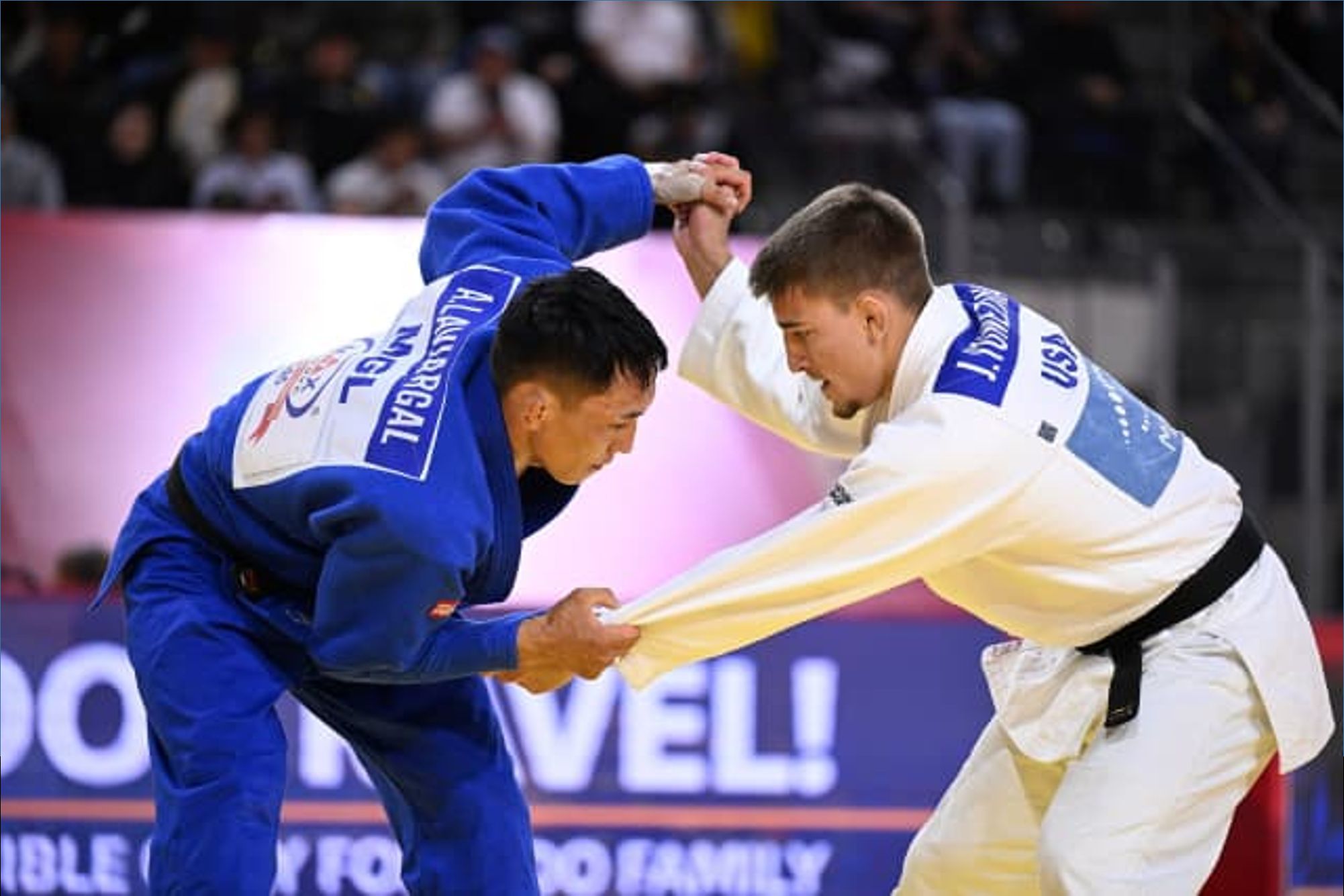
Ankhzaya Lavjargal beats Jack Yonezuka (Photo IJF)
The men’s -73kg category delivered exactly the kind of surprises that make judo so captivating, the kind that keep spectators on the edge of their seats, wondering what could possibly happen next.
Everything began with the early elimination of one of the favourites, Makhmadbek Makhmadbekov of the UAE, who was stopped in his opening contest by Italian Manuel Lombardo. In what had been a rather tactical contest, the Italian produced a magnificent ura-nage to score and eliminate the highly ranked judoka. Unfortunately for Lombardo, his Mongolian adventure ended in the next round and it was eventually Uranbayar Odgerel of Mongolia who progressed to the semi-final. He was joined by the American Jack Yonezuka.
Yonezuka was certainly not an unknown name on the World Judo Tour, but his victory over Odgerel marked the first time he had reached a grand slam final. Even before stepping onto the tatami for the gold medal contest, he had already guaranteed himself a first medal at this level. Before arriving in Ulaanbaatar, Yonezuka had competed in 25 grand slams, with a fifth place and two seventh places as his best results. His breakthrough in Mongolia was therefore a perfect illustration that perseverance and patience can eventually be rewarded.
On the lower half of the draw, the absence of Olympic champion Hidayat Heydarov (AZE) left the path wide open. It took time for the picture to become clear but after a series of close contests, it was the second Mongolian athlete, Ankhzaya Lavjargal (MGL), who secured his place in the final, overcoming young British judoka Irakli Goginashvili (GBR) in a very tight semi-final. For Lavjargal, it was also a first appearance in a grand slam final.
After a demanding and intense day, the two finalists displayed incredible physical resources, maintaining a high pace throughout the four minutes of normal time before continuing for more than two additional minutes in golden score. Then, with a moment of inspiration and perfect opportunism, Lavjargal found the opening to throw Yonezuka with uchi-mata. The moment the Mongolian crowd had been waiting for had finally arrived. After two bronze medals, the host nation celebrated its first gold medal of the tournament, won by Ankhzaya Lavjargal in front of a jubilant home crowd.
As he left the tatami, Ankhzaya Lavjargal declared, “I am so happy and grateful to have won my very first grand slam gold medal right here in my own country. Standing on the mat during such a tough fight, especially when it went deep into golden score against Jack Yonezuka, I kept pushing forward by reminding myself how incredibly hard I trained for this exact contest. Hearing the hundreds of people cheering, shouting my name and celebrating the victory, gave me so much energy. I am so proud that my hard work paid off. I don’t quite know how I am going to celebrate this achievement just yet, but thank you all so much for your incredible support and cheers. Winning this Olympic qualification event at home means everything and I am excited to keep moving forward on my journey toward the Los Angeles Olympics.
Haruka Kaju claims Japan’s fifth Gold Medal
One of Mongolia’s greatest hopes for a medal rested on the shoulders of Enkhriilen Lkhagvatogoo of Mongolia, who began her day as the women’s -63kg number one seed, a significant advantage when competing in front of a passionate home crowd.
Winning the Qazaqstan Barysy Grand Slam 2026 last May launched her campaign without difficulty, but the challenge became much greater in the quarter-final against the powerful Lubjana Piovesana of Austria. Unimpressed by the atmosphere and the pressure, Piovesana remained patient and eventually scored waza-ari during golden score to eliminate the Mongolian favourite.
Piovesana still had to overcome the obstacle of the semi-final, where she faced 2024 world champion Joanne Van Lieshout of Netherlands. This time, the Austrian could not maintain her impressive winning streak, as Van Lieshout demonstrated her class by scoring ippon and securing another grand slam final appearance.
With the world number one out of contention, attention turned to the world number two, Haruka Kaju of Japan, who booked her place in the final after a series of commanding performances to come through the preliminary rounds.
The final therefore brought together Joanne Van Lieshout and Haruka Kaju, two of the leading figures in the category. The contest remained perfectly balanced for a long time, until both athletes moved into ne-waza, an area in which Japanese judoka traditionally excel.
Van Lieshout came close to being caught in Kaju’s carefully prepared trap. Although she resisted both on the ground and standing, the Dutch athlete gradually found herself under pressure and was unable to take control of the contest. Two penalties increased the pressure on her and with less than twenty seconds remaining, a third shido was logically awarded, giving Haruka Kaju the gold medal, the fourth grand slam title of her career and Japan’s fifth gold medal in Mongolia.
After her final, Kanu said, “Today, I was glad to showcase the standing techniques I’ve been practising, rather than just relying on ground work. Looking ahead, the road to the Los Angeles Olympics is long. I intend to take it one tournament at a time, focusing first on winning the world championships this year. In the final, my opponent had a very strong defence system and although I maintained a solid performance, I couldn’t completely finish the match with ne-waza. This gives me a clear area to improve moving forward.
Regarding my undefeated streak, I don’t know the secret myself. I am simply grateful to everyone around me; my team ensures I step onto the tatami in perfect condition and then my job is to express that support through my performance. Competing in Mongolia has been a joy. Judo is incredibly popular here and even though I wasn’t the local athlete, the crowd cheered warmly and gave me a wonderful reception.”
Shiho Tanaka confirms her World Champion status
The women’s -70 kg category was packed with quality, featuring several world and Olympic medallists among the contenders for the title at this grand slam.
Opening the Olympic qualification period without too many surprises, even if her journey was far from straightforward, the number one seed Aoife Coughlan of Asutralia became the first athlete to secure her place in the final. Her route was consistent and focused, with notable victories over Delger Jargalsaikhan of Mongolia, Sinem Oruç of Turkey, Sanne Van Dijke of the Netherlands and finally Miriam Butkereit of Germany in the semi-final.
In the lower half of the draw, after the elimination of several other favourites, it was Shiho Tanaka of Japan who booked her place in the final against Coughlan. A serious challenge awaited the Australian, as Tanaka is none other than the reigning world champion. This also serves as a reminder that Japanese judoka, who sometimes compete less frequently on the World Judo Tour than athletes from other nations, do not always have a world ranking position that reflects their true level.
The final promised to be a hard-fought battle and many expected the advantage to lie with Shiho Tanaka. However, Aoife Coughlan offered strong resistance and pushed the Japanese judoka throughout the contest. In the end, a single yuko was enough to separate the two athletes, giving Tanaka the gold medal and Japan its sixth gold medal of the Ulaanbaatar Grand Slam.
Shiho Tanaka said, “Since I came to Mongolia to collect Olympic qualification points, I wanted to make sure I keep winning my upcoming matches to firmly connect this path to the Olympics. Coming back here for the first time in three years and winning this grand slam for the second time makes me incredibly happy. While everyone wants to beat the world champion, I didn’t actually feel too much pressure out there; I am just really glad that I was able to stay focused, push through and thoroughly secure the victory.
Lee Joon-hwan ends a perfect day with a spectacular gold
At just 22 years of age, Timur Arbuzov of Russia is already firmly established at the top of the World Ranking List following his world title in Budapest last year and his continental title in Georgia earlier this season.
He therefore arrived in Ulaanbaatar as the number one seed and his opening contests left no doubt that he was in excellent form, once again displaying the spectacular and attractive style of judo that has become his trademark.
In the semi-final, he faced a major challenge in the form of world and Olympic medallist Joonhwan Lee (KOR), two years his senior and equally capable of producing judo that combines technical precision and explosive power. It was Lee who emerged victorious after a high-level contest in which he scored twice, leaving the reigning world champion without an answer. Lee therefore secured his place in the final.
In the lower half of the draw, the scenario was much clearer as the two favourites, François Gauthier Drapeau of Canada and Yuhei Oino of Japan, met in the semi-final. The suspense did not last long. With exceptional timing and finesse, Oino scored with a spectacular de-ashi-harai for ippon from the very first gripping exchange, confirming his place in the final.
The gold medal contest therefore brought together two of the strongest athletes of the day, Joon-hwan and Yuhei Oino. Through the competition, Lee had looked increasingly confident, precise and incisive, as though each contest was preparing him for one final demonstration of his talent. In the final, he produced perhaps the most spectacular technique of the entire final block.
A superb ippon ko-uchi-gari, combined with a powerful change of direction, left Oino with no chance of escape. It was a perfect ending to a perfect day for the Korean judoka, who captured the gold medal in impressive fashion.
Joon-hwan declared, “It feels incredible to win in Ulaanbaatar again after a year away from this tournament. I’ve spent the last year itching to compete and analysing my opponents deeply, so seeing that hard work pay off today is amazing. However, with more than two years left until the Los Angeles Olympics, I can’t lose focus. Beating top athletes today doesn’t guarantee a victory next time, especially since they will now be studying me even closer. That’s why I constantly live and breathe judo, even during my downtime. My ultimate goal isn’t just a single gold medal in LA; I want to win again in Australia afterwards to become the first Korean judoka to achieve back-to-back Olympic titles. People say I’m young but there are already younger world champions out there. Today’s win doesn’t make me the best in the world yet, so I’m going to work myself to death and train as hard as possible until the Olympics.”