

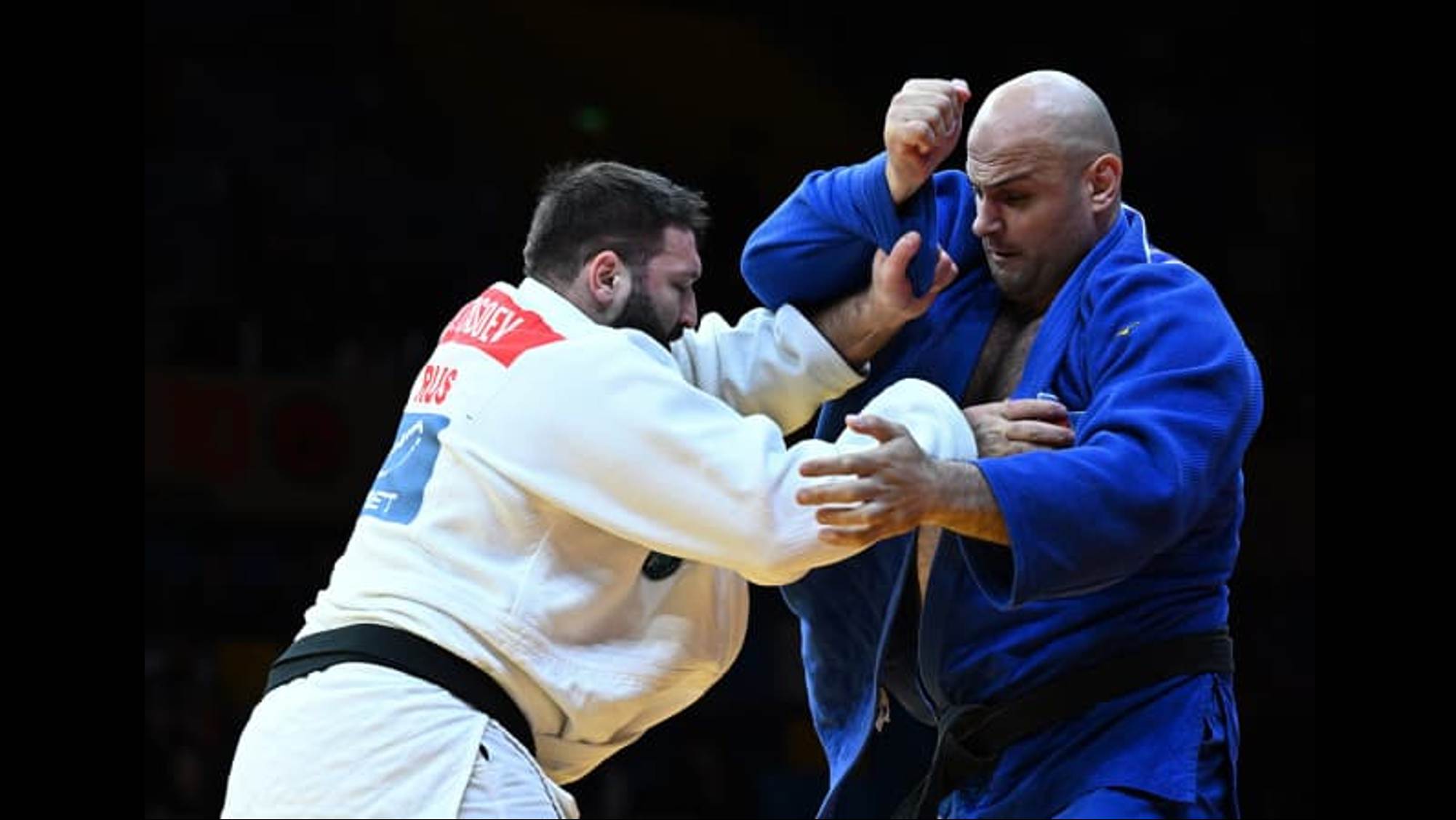
Inal Tasoev of Russia beats Azerbaijan's Ushangi Kokauri (Photo IJF/Gabriela Sabau, Tamara Kulumbegashvili)
Current and double world +100kg champion Inal Tasoev of Russia had led from the beginning of his day, never looking ready to accept a mistake or a loss at the Qazaqstan Barysy Grand Slam.
In the final, against Azerbaijan’s Ushangi Kokauri, the 2018 world silver medallist, Tasoev, was less open than in his previous contests. He led by a single Yuko until the gong. It was a demonstration of his ability, his strategic thinking and his excellence. Tasoev had his eleventh grand slam gold; what a record.
After the final, Inal Tasoev said, “I am incredibly happy and satisfied with my performance today, as I truly love the energy and support from the crowd here. Having competed at this level for many years, I’ve learned to stay focused; the attention doesn’t bother me, but rather motivates and energises me. It is also a huge compliment to hear such positive feedback about our team’s performance on social media. These things always help.”
Baikamurov raises the host nation flag
Vadim Ghimbovschi of Moldovia had an uphill climb on his hands in the -100 kg final at the Zhaksylyk Ushkempirov Martial Arts Palace in Astana. His opponent, Marat Baikamurov, was being driven hard by the crowd; they wanted another gold for Kazakhstan after Zhaglas Kairolla won their first gold on day two.
They saw their wish realised when Baikamurov caught Ghimbovschi for a yuko with an ambitious o-uchi-gari. The Moldovan gave everything he had to pick his opponent up, engaging fully, but Baikamurov was inspired and held his ground.
It was his first gold, having taken the silver last years at the Qazaqstan Grand Slam.
“I am deeply proud to win gold at home and sing our national anthem. The crowd’s support gave me immense strength rather than pressure. Using Qazaq kuresi techniques helped me maintain control in the final. This team victory gives me great confidence moving forward and we will definitely celebrate together as it is our triumph not just mine,” said Baikamurov.
Rutovic delivers open and powerful judo
Serbian teen sensation Boris Rutovic exceeded all expectations in Astana. En route to the -90kg final he took out Latisev of Moldovia and De Wit of the Netherlands, not afraid to throw, to engage or to lead. He has an exciting style and was ready to use it to the best of his ability against Guilherme Schimidt of Brazil for the gold medal.
As the final began, both athletes struggled to find their usual rhythm, blocking one another’s attacks. There was action and effort but nothing hit the mark.
As frustration deepened towards the dying seconds of normal time, Schimidt attempted to throw with an o-soto-gari but Rutovic was ready and turned it to his advantage, countering for a yuko. There were only 18 seconds left and so that score remained the sole score of the contest.
Nineteen-year-old Rutovic has thrown his hat into the ring in Astana, a teenager with goals and drive, one to watch on the not-so-long road to Los Angeles.
He was satisfied with his performance in Astana, saying, “This is my second grand slam and I’m incredibly proud to have won my first gold medal. As I’m often younger than my opponents, I push myself to give over 100% and use my strength to win. It was special winning the final in Kazakhstan as the crowd here truly understands judo.”
Olek and Boehm continue the German race
The women’s -78 kg category has long included German representatives on its podium. World, Olympic and European medals have been won by Wagner, Boehm and Olek for several years and so it was no surprise to find Anna Monta Olek and Alina Boehm in a German derby for gold in Astana.
It was always likely to be a close contest and in the end it couldn’t have been closer. Olek took the win on penalties, 3-2, after edging the exchanges with more dominant gripping than her teammate. Two German flags would hang above the podium nonetheless.
After the final Olek said, “I am happy as I followed our plan perfectly in the early rounds. Facing my teammate in the final was tough because we know each other so well, so making throws is difficult. I won by staying mentally consistent and forcing attacks to avoid penalties. The gold in Astana shows that we made a great decision by not competing in the European Championships and to have additional practices.”
Startseva wins in an unpredictable category
The women’s heavyweight +78lg category was open and unpredictable. Many of the biggest names were missing but sometimes that kind of draw leaves space for new stars to be found.
In the final Kamila Berlikash gave the host nation hope of a gold medal, but Elis Startseva of Russia was unwilling to concede. In fact she worked fast and with well-drilled technique to make space to armlock Berlikash in just over a minute. The crowd were not happy but good judo must always be appreciated and today Startseva earned her place on the top step of the podium.
After the final Elis Startseva said, “Winning gold in Kazakhstan is an incredible feeling and I am so grateful to the fans for their amazing support. I stayed focused on my own judo and strategy which helped me manage the pressure of the final. This victory is a result of the hard work put in by our entire team and our coach.”